

CORNING, N.Y. (September 10, 2025) – On September 4, racing legend Brian Redman was honored at a gala dinner, presented by Sahlen’s, with the 11th annual International Motor Racing Research Center’s Cameron R. Argetsinger Award for outstanding contributions to motorsports.
Held at the Corning (N.Y.) Museum of Glass, which recognized multi-race team owner Chip Ganassi at the inaugural dinner in 2014, Redman was presented with an etched glass trophy by founding member and past president of the IMRRC, J.C. Argetsinger. Famed motorsports TV broadcaster Dr. Jerry Punch was the Master of Ceremonies, and another racing legend, David Hobbs, along with renowned TV commentator Bob Varsha, conducted the spirited Q&A with Redman. “Doc” Punch has been the voice of the Argetsinger Award presentations for 10 of the 11 years.
“Brian was as much a part of the British Invasion as any long-haired musician. He came to our shores, he saw, he looked around and he conquered American road racing, earning legions of fans. I can think of no other person who more deserves this award tonight for outstanding contributions to motorsports than Brian and I’m so proud to be here,” said J.C. Argetsinger, Cameron’s eldest son and a retired Schuyler (N.Y.) County judge.
Said Hobbs: “Brian is a very worthy recipient of this award. He is one of the best long-distance drivers ever. He’s had many wins in a very dangerous era. Not many people can say they beat Mario Andretti three years in a row [in the F5000 series].”
“As many times as I’ve heard Brian speak, reminisce, or just pass the time, it always fascinates me to be in his company,” said Varsha. “He, David and I could have prattled away for much longer tonight. Seeing him receive the distinguished Argetsinger Award will be a great memory.”
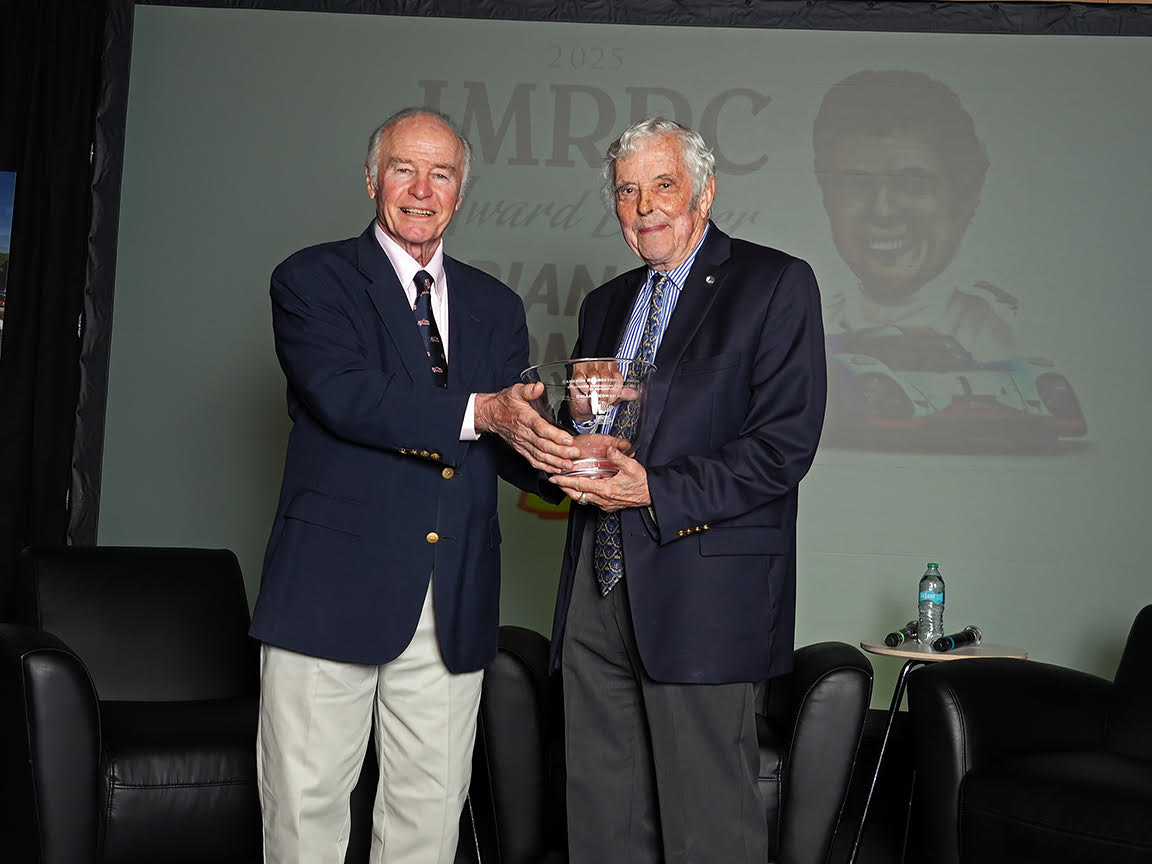
Brian Redman, right, with J.C. Argetsinger, holding the Cameron R. Argetsinger Award. (Pete Gorski image)
Video shout-outs were shown, sharing congratulatory messages from racing and industry celebrities, including Mario Andretti, Sam Posey, Hurley Haywood, Bobby Rahal, Danny Sullivan, IMSA’s John Doonan, Revs Institutes’ Miles Collier and Scott George, Roger Penske, Zak Brown and Lyn St.James.
Particularly poignant were the video tributes presented by former FIA Senate President Nick Craw and former race-car driver Kathy Rude, commenting on how Redman’s perseverance following Rude’s 1983 major crash in Brainerd, Minnesota, resulted in sanctioning groups upgrading their Catastrophic Insurance policies.

Argetsinger Award honoree Brian Redman, center, was interviewed by racing legend David Hobbs, left, and renowned TV commentator Bob Varsha. (Pete Gorski image)
“This evening was really amazing and it’s a wonderful reflection of the IMRRC and the work that it does,” said Redman. “Cameron has been rightfully lauded for all the work he did to organize the original races in Watkins Glen and bring the sport into the professional era. This was an astonishing presentation tonight, and it means a great deal to me. It’s probably the best honor I’ve ever received. Thank you.”
John Saunders, Chairman of the IMRRC Governing Council, spoke about the IMRRC’s mission to help preserve the important legacy of motorsports, focusing on major future growth plans for the research center.
Margaret Lawrence, Interim Executive Director of the IMRRC, said: “Presenting the Cameron R. Argetsinger Award serves the dual purpose of honoring an outstanding contributor to motorsports while also providing an enjoyable evening for guests and sponsors who appreciate the mission of the IMRRC. They in turn participate in one of the IMRRC’s most significant annual fundraising events. The dinner was a resounding success. Brian Redman was a deserving honoree. Many of our event sponsors have been with us since the beginning, a further endorsement of our mission to preserve motorsports history.”
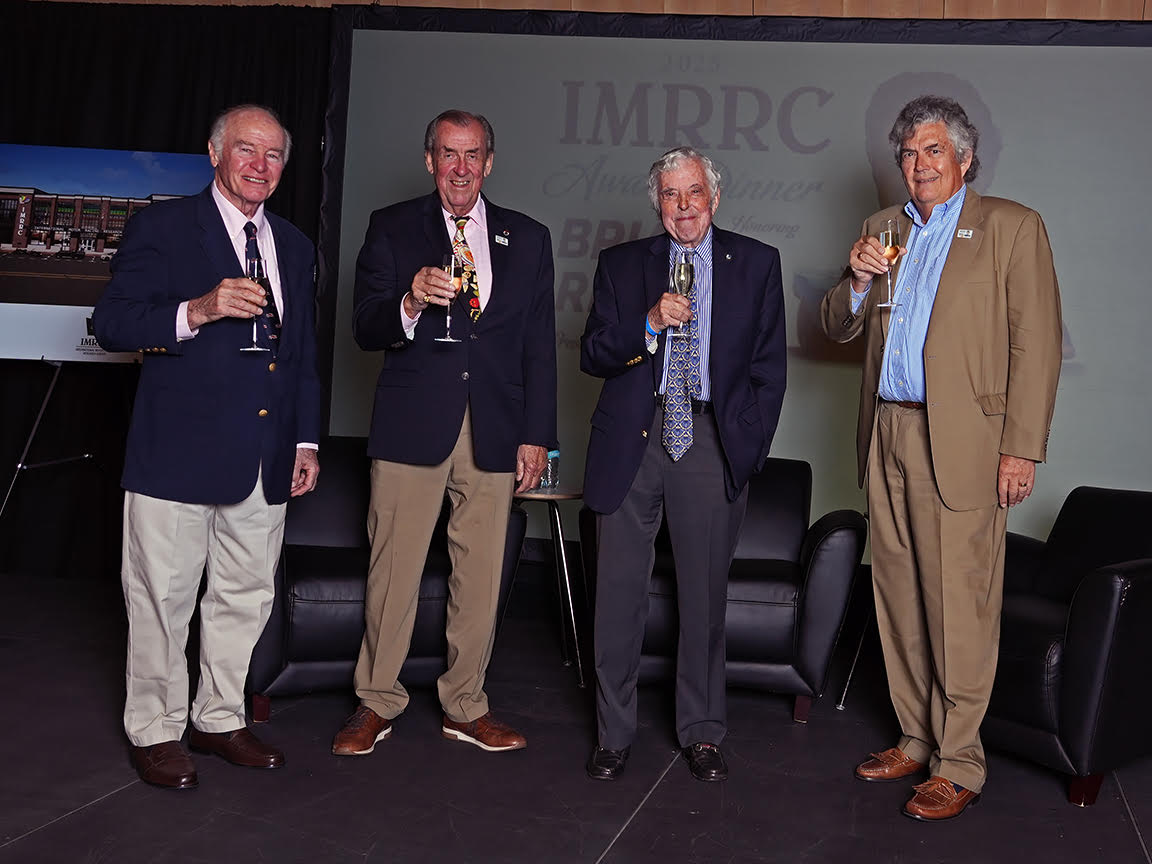
From left, J.C. Argetsinger, David Hobbs, Brian Redman and Bob Varsha share a champagne toast. (Pete Gorski image)
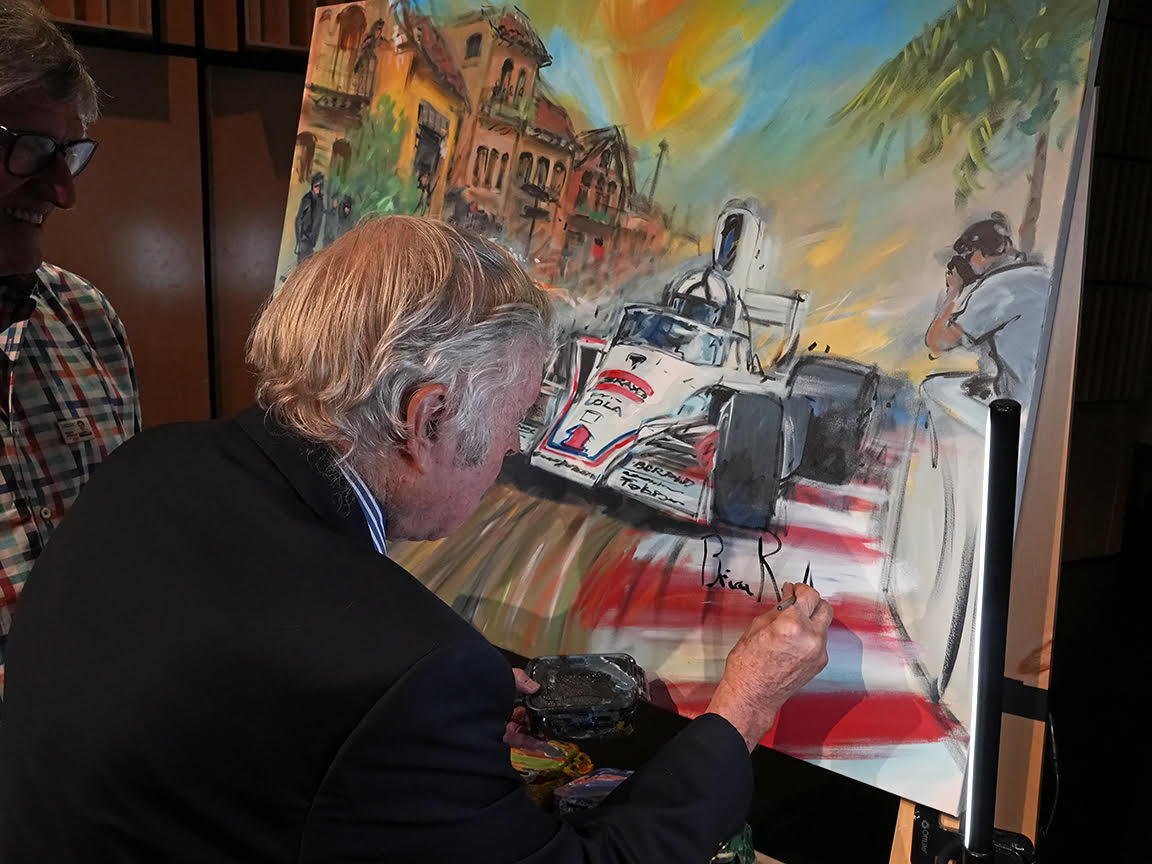
A 60″x42″ acrylic painting created during the reception and gala by famed motorsports artist Bill Patterson was auctioned off at the end of the evening. It depicted two race cars significant to Redman’s career: the 1970 Targa Florio-winning Porsche 908/3 of Redman and Jo Siffert, with Redman driving through a village in Sicily alongside the Lola T332 Formula 5000 car he raced to victory at the inaugural Long Beach Grand Prix in 1975.
 |
 |
| Brian Redman (left) signs the original artwork created by artist Bill Patterson during the evening, as Dr. Jerry Punch (right) is at the podium as the Master of Ceremonies. (Pete Gorski images) | |
On display at the entry of the Museum was a Watkins Glen International Toyota Camry Pace Car, and the BMW M49 CSL that Redman drove to victory at the 1976 24 Hours of Daytona.
Established in 2014, the CRA Award has been presented to such legends of the sport as Chip Ganassi, Roger Penske, Mario Andretti, Richard Petty, the France Family, Bobby Rahal, Lyn St. James, Mike Helton, Richard Childress and Zak Brown. All proceeds benefit the 501(c)(3) IMRRC.
The award memorializes Cameron R. Argetsinger, often referred to as the father of American road racing. He was a visionary who, in 1948, conceived, organized, and drove in the first post-war road race in America through the roads of Watkins Glen. He brought Formula 1 to WGI in 1961 and the circuit hosted the United States Grand Prix for 20 years. He was president of the IMRRC for five years, until his death in 2008.
Sponsors and supporters of the Cameron R. Argetsinger Award dinner included Sahlen’s; Chemung Canal Trust Company; Revs Institute; NASCAR/WGI; SCCA Inc.; SCCA Foundation; Hilliard Corporation; The Gorsline Company; Larry and Karen Kessler; Glenora Wine Cellars; Greg Galdi; Global Prairie; Welliver; Simmons Rockwell; and John H. Cook Jr. Painting.
The following is an excerpt from “IMSA 1969-1989” that tells the inside story of John Bishop’s life and how he created the world’s greatest sports car racing series. Available from Octane Press or wherever books are sold.
_____________________________________________________________________________________________
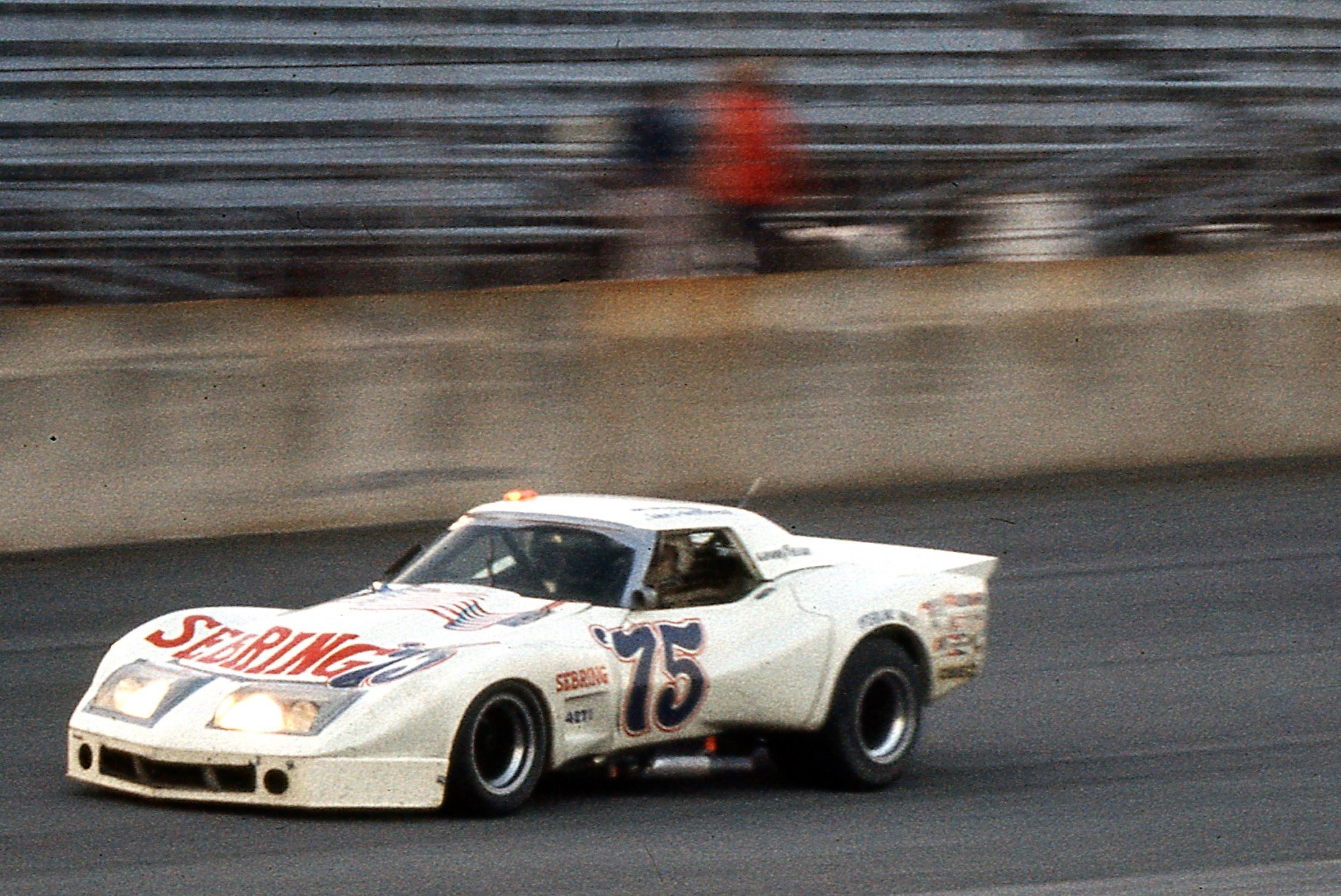
John Greenwood’s Corvette under braking for turn one during the 1975 24 Hours of Daytona, featuring his paint scheme promoting the 12 Hours of Sebring a few weeks later. Photo: Mark Raffauf
After a troublesome start at Daytona and subsequent upgrades to the car, the two-car factory BMW team showed up for the 12 Hours of Sebring in 1975 ready to mix it up. Australian touring car ace Alan Moffat supplemented the potent team of Hans Stuck, Sam Posey, Brian Redman, and Ronnie Peterson. The CSLs were now much improved and took advantage of specially crafted Dunlop tires. The old 5.2-mile Sebring course was a wide-open, hang-on-and-get-after-it circuit, where turns one and two were big, sweeping curves of concrete runway that required tremendous skill to navigate quickly without going off and hitting anything, including parked airplanes.
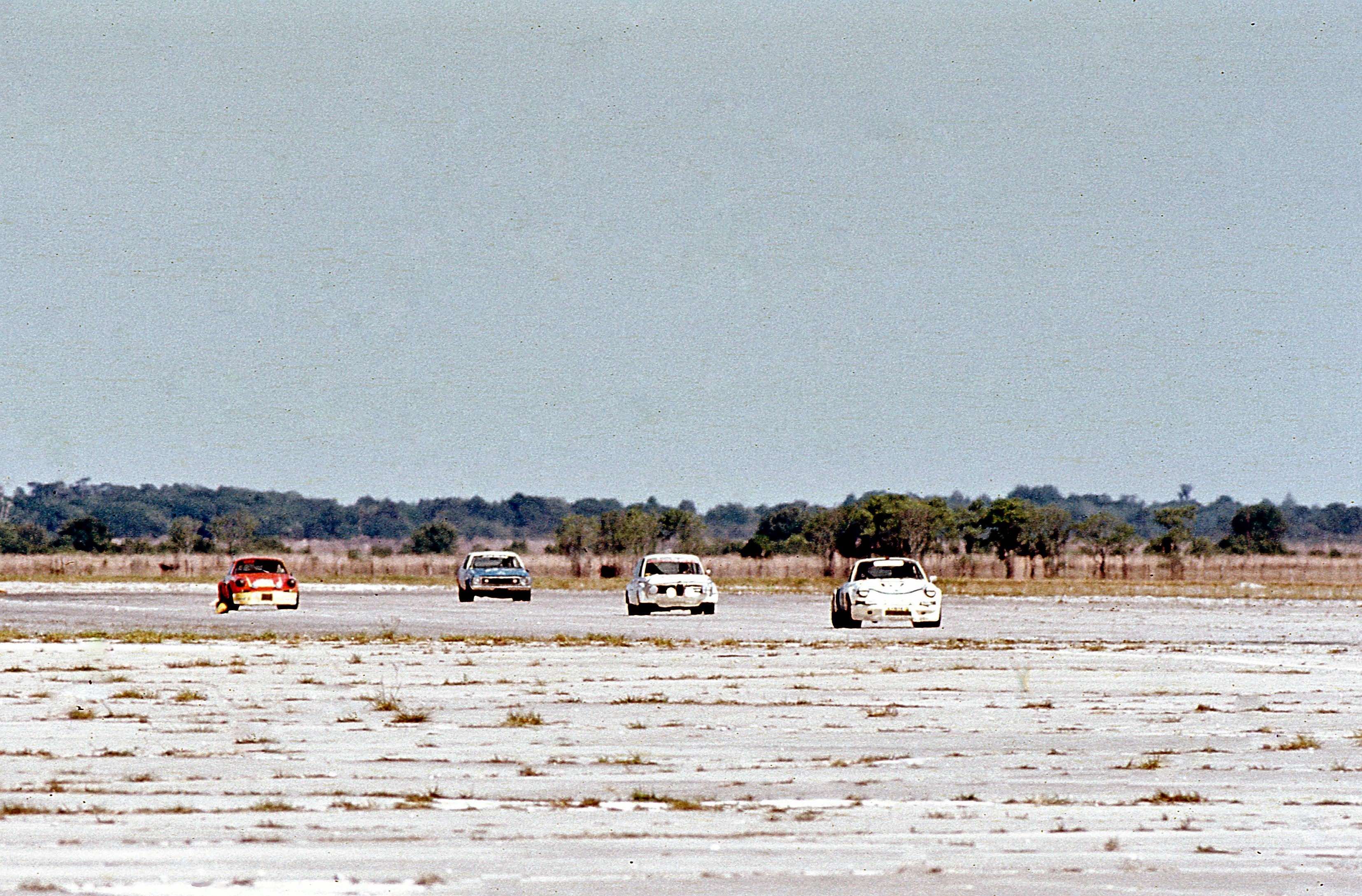
GT cars make their way down the massive back straight at Sebring in 1975. The runways of Sebring weren’t always as well marked as they are today. Nighttime navigation of the track was especially challenging. Photo: Mark Raffauf
In spite of John Greenwood’s Corvette taking pole, the BMWs stormed into an early lead. Within the first hour, Hans Stuck’s BMW was reported numerous times by corner workers at various locations not to have working brake lights. IMSA black-flagged the car to have its lights checked. Once in the pits, it was determined the lights were indeed working. A short time later the same reports started coming in: no brake lights, especially in turns one and two. The car was brought back in for another check. Again, all was good while stationary in the pits.
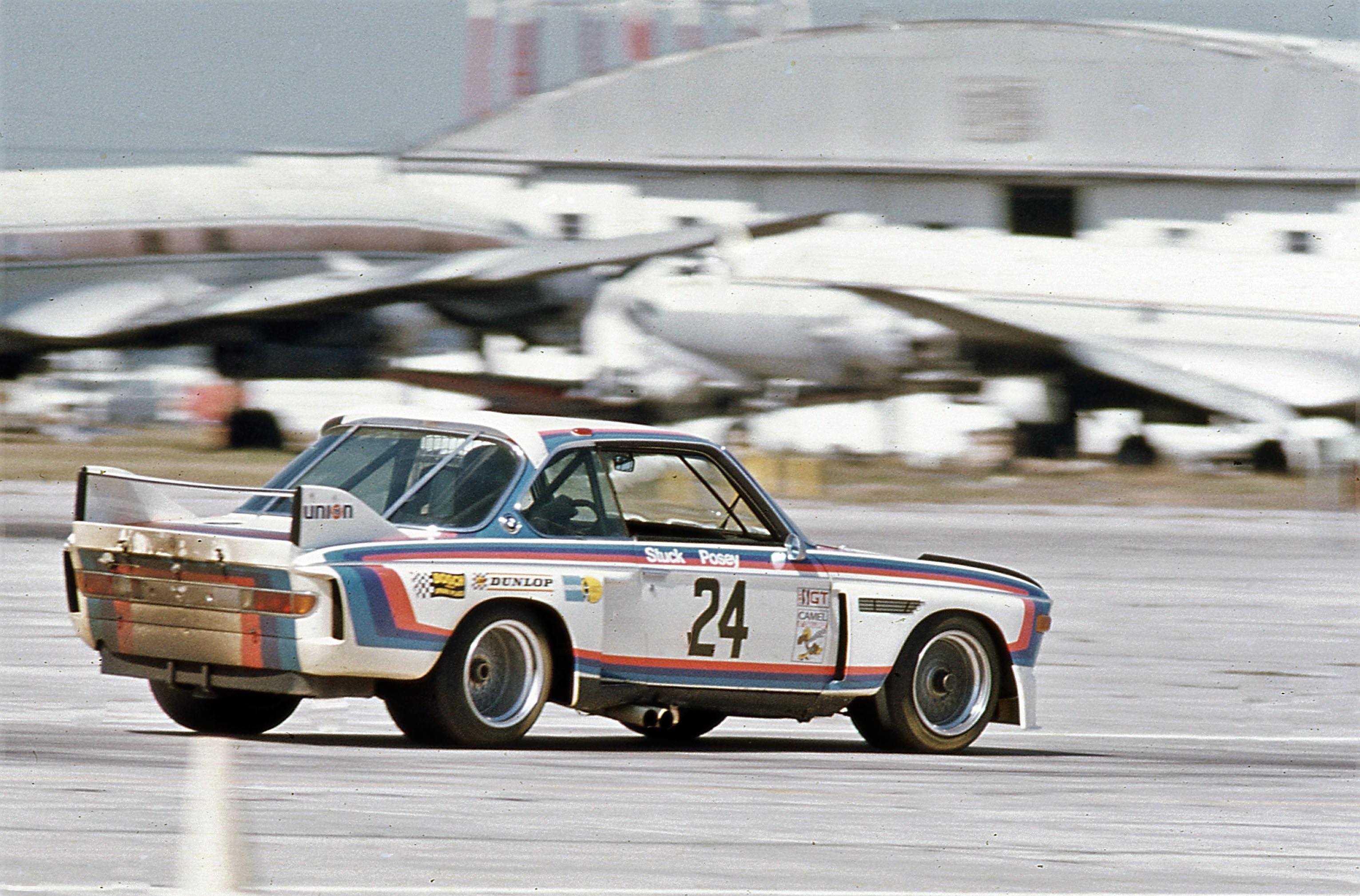
The winning factory BMW CSL of Hans Stuck, Sam Posey, Brian Redman, and Allan Moffat navigates the wide-open runways of Sebring in 1975 when Lockheed Constellations and Douglas DC-4s lined the course unprotected between turns one and two. Photo: Mark Raffauf
When the issue arose a third time, BMW team chief Jochen Neerpasch asked IMSA officials, “Where are the lights not working?” to which race control replied, “Various locations, including turns one and two.” Neerpasch responded with, “Oh, Hans does not use the brakes there at all!” With the stickier tires and improved performance, GT cars were now able to take turns one and two flat, or at least with a slight lift instead of braking. No one had ever seen that before, hence the confusion from the corner workers and race control.

The winners of the 1975 12 Hours of Sebring celebrate in Victory Lane. Sam Posey stands on top of the BMW CSL, flanked by Brian Redman (far right), Hans Stuck (seated next to Redman) and Allan Moffat (with daughter). Photo: Bill Oursler/autosportsltd.com