

- This event has passed.
Carrera Panamericana Team at IMRRC
WATKINS GLEN, N.Y. (Dec. 1, 2014) – The challenge of 2,000 miles in seven days, across mountain ranges and along serpentine Mexican roads, has framed the resurrected Carrera Panamericana as the last great road rally.
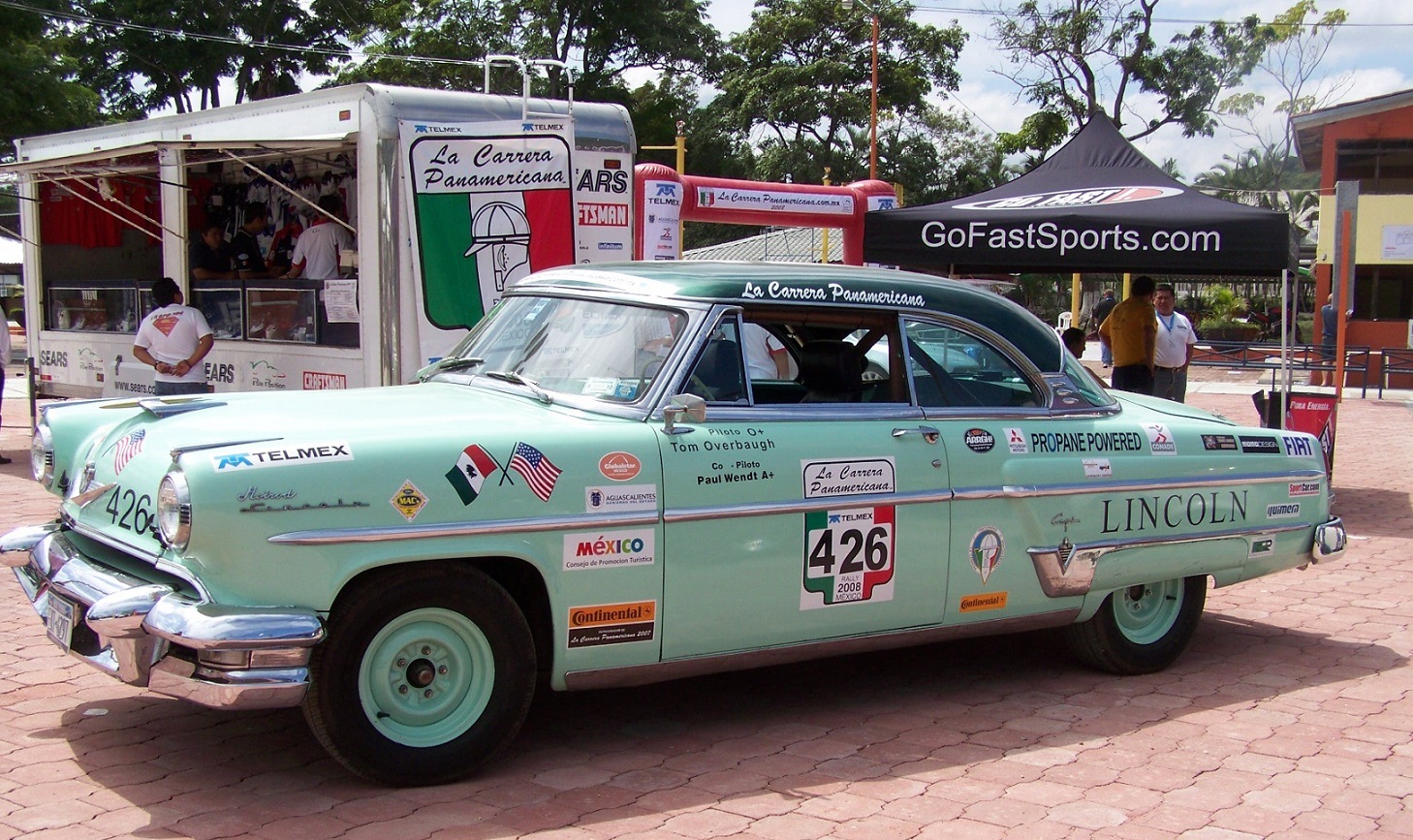
On Dec. 13, New York state residents Tom Overbaugh and Paul Wendt will speak at the International Motor Racing Research Center about their five years of grueling competition in the Panamericana at the helm of a mintgreen 1954 Lincoln.
The Center Conversations talk is free and open to all. The Center is located at 610 S. Decatur St., Watkins Glen.
The talk will be preceded by the drawing of the winning ticket for the Fiat 500 Abarth Turbo and trip to Italy offered as the grand prize in the Center’s annual fund-raising raffle. The ticket will be drawn by Anthony J. Specchio Sr., grand marshal of the 2014 Italian-American Festival in Watkins Glen. Tickets will be sold until 12:45 p.m. The winning ticket will be drawn at 1 p.m., and the program by Overbaugh and Wendt will begin shortly thereafter.
Overbaugh’s first exposure to the Panamericana was as a crew member in 2007. He was behind the wheel of his Lincoln the next five years. Wendt was in the navigator’s seat for three of those years. “Every year we got farther in the race, and every year we got better,” Overbaugh said.
The men completed the 2,000-mile rally in their last running, in 2012. They are planning to bring the “Green Lincoln” to the Center. The exhilaration of competing in the Panamericana is matched by the camaraderie that develops among the teams of both professionals and amateurs, Overbaugh said.
“Everybody helps everybody,” Overbaugh said. “There’s no money in this race. It’s just a lot of fun.”
A field of 100 cars competes in 10 to 15 different classes, comprising vintage vehicles from motorsports history to the newest sports car models. The original Carrera Panamericana ran from 1950 to 1954. It was organized to celebrate the completion of the Mexican section of the Pan-American Highway in 1950.
The first event was a nine-stage, six-day race almost entirely along the new highway, crossing the country from north to south for a total distance of 2,096 miles. Drivers from every type of racing and from around the world competed in a wide range of cars. Described as “tragic and exhilarating in equal measures,” the Panamericana was abandoned because of safety concerns. Twenty-seven people died during the five-year run.
The Carrera Panamericana was revived in 1988 and uses some of the original course. Competitors drive upwards of 350 miles a day over the seven days.
The 2015 Center Conversations series will launch on Jan. 24, when Center historian and Watkins Glen racing expert Bill Green speaks on “Racing Things: Patches, Programs, Credentials and Other Things.”
The Racing Research Center is an archival library dedicated to the preservation of the history of motorsports, of all series and all venues, through its collections of books, periodicals, films, photographs, fine art and other materials. For more information about the Center’s work and its programs, visit www.racingarchives.org or call (607) 535-9044.