
By Luis Martinez
“The best thing to do is to keep it quiet as long as you could.” Don Cox explained to an audience at the 25th Amelia Island Concours d’Elegance, responding to the need to test, prepare, practice, and try out new ideas to improve performance or logistics before approaching The Captain. Roger Penske was of a mind to do things the right way within the bounds of competition rules. What Penske did not want is to do well only to be told by Scrutineering that his car was disqualified. Cox continued, “I saw that during a pit stop once in a while: a car would come in and if it had a flat tire you couldn’t get jacks under the car. So I thought, we have to have a better way to do it. We tried air jacks for the first time in 1974, ‘75, but I was afraid to show all that to Roger because I didn’t know what would happen. We practiced with the air jacks at the local Sunoco refinery, our sponsor. We went over there, we were practicing and we plugged in the air hose and the car jumped up. Roger looked at it, and he looked at me, and he said, “This is a great idea!” That was the start of air jacks on racing cars. All cars have air jacks now.”
Don Cox started his career as an engineer with Chevrolet’s Research and Development after graduating from General Motors Institute. He worked on many projects in Chevrolet R&D including Jim Hall’s Chaparral from 1965 to 1968. In March of 1969, Cox was assigned to work with Team Penske in the Trans Am program as an advisor while Penske was running two Camaros in Trans Am – the #6 piloted by Mark Donohue and the #9 by Ronnie Bucknum. In November 1969 when he joined Penske’s racing shop at Newtown Square, PA, he became the team’s first dedicated engineer. “I was chief engineer because I was the only engineer!” Cox grins. In that race shop, his responsibilities touched every part of Team Penske’s racing enterprise – the TransAm cars, Indy cars, World Endurance Racing Ferrari 512 and both Porsche 917-10 and 917-30 Can-Am Champions. Cox and Mark Donohue designed Penske Racing’s first custom-made race shop when the team moved from Newtown Square to Reading, Pennsylvania in 1973. In the words of Bill Warner, founder and chairman of The Amelia Island Concours d’Elegance, Cox is “the man who saw it all.”
Cox reminisces about those days: “Looking back to 1969, I started with Roger when the shop was an old cinder block garage with 4,000 square feet and a crew of eight guys.” The Captain also reminisces about those early years: “One little shop at Reading, we were doing CanAm, we were doing TransAm, we were doing Indy, and I think we were doing IROC. All out of the same shop, think about that! All those disciplines out of one small shop in Reading, Pennsylvania. Again, why were we successful? All about the people, and to me, that’s the greatest thing we have – the colleagues and associates around us.” Including Don Cox.
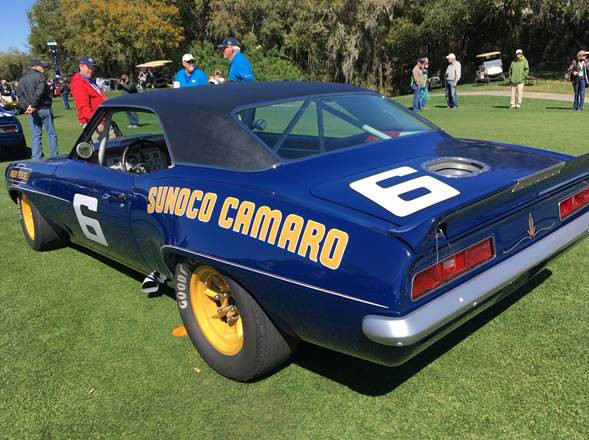
1969 Camaro, 305cid ovh valve V-8, two four-barrel carbs, 440 bhp, 2,980 lb. dry, 4-speed transmission, Corvette brakes, Goodyear Blue Streak Racing tires. Caption source: Car Life Magazine, January 1970. Photo: Luis A. Martínez
The beautiful Sunoco Blue liveried Camaros, the #6 car and #9 car, were very successful. So why leave GM to go to Team Penske and switch efforts to American Motors? Cox explains: “Penske had been running Camaros for a couple of years so during 1969 I had worked for Chevy R&D with the Penske project. But the official position of GM at that time was “no racing.” Other than technical assistance, Roger could not get any financial support from GM. By November I began working full time for Roger on a new program – American Motors’ Javelin, to make it competitive.”
Although Penske was a Chevrolet dealer, his relationship with GM on the racing front had gone sour so he felt compelled to explore working with a different vehicle. Towards the end of 1969 Penske initiated talks with American Motors Corporation. The deal with AMC proved lucrative – two million dollars for the season employing the 1968-69 TransAm championship team.
Penske had seen Javelins only at a distance, so this was all new territory and full of risk, as he knew AMC had struggled with their Javelin entries while he, Donohue, and Revson had secured two championships. Penske decided to bring back Peter Revson to race the second Javelin with Donohue.
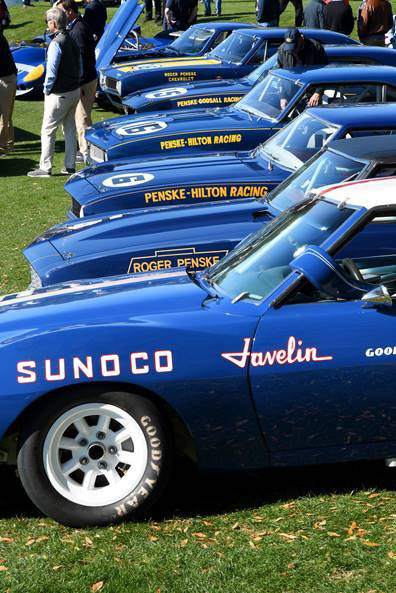
The Penske Racing stable included a plethora of Sunoco-clad Can-Am racers, with Mark Donohue, Peter Revson, and George Follmer among pilots. Photo: Anthony J. Bristol
There were some important carryovers from the Camaro program to the Javelin effort, and it paid quick returns. “In 1970, Penske carried the numbers six and nine from the Camaros to the Javelins,” explains Cox. “Up to that point, the Javelins were not competitive. Donohue drove the #6 Javelin and Peter Revson was assigned #9. In 1970, after winning the championship with Camaros in 1968 and 1969, our Team Penske Javelin team was only one point short of the championship in 1970, but we beat all the other Camaros. So our Penske #6 Javelin with Donohue was very successful in 1971, winning seven out of ten races and finishing second or third in the rest.”
When Cox arrived on the scene from Chevrolet Development he immediately started on a new suspension for the Javelin, which was bottoming out, running on bump stops virtually all of the time on track. Cox designed the entire rear end, which included the housing, axles, full-floating hubs, spool, linkage to locate the rear, and brakes. Cox pointed out to Penske the advantage of Girling disc brakes with Lincoln rotors.
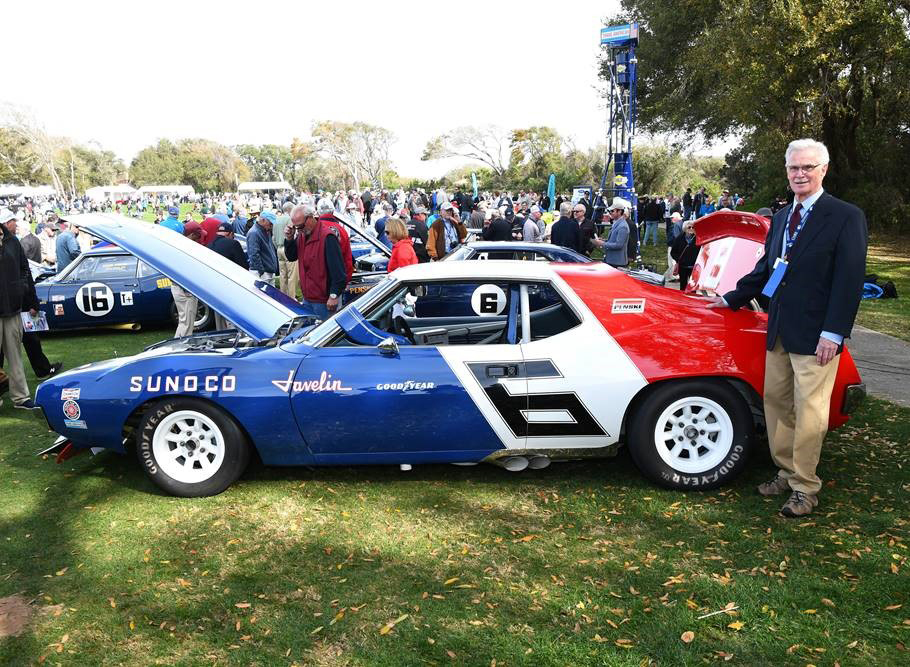
Don Cox and 1971 Trans-Am champion AMC Javelin at 25th Annual Amelia Island Concours d’Elegance. Photo: Anthony J. Bristol
As for the engine, Penske needed to develop special AMC engine components as the 290 CID was down 100 horsepower to the competition. Team Penske looked to Traco in California for all the engines for the 1970 season. Regulation limited engine size to 305 CID. Traco managed to shrink a 360 to regulation by destroking, while still making over 400 horsepower comparable to Chevrolet. But then there developed a litany of blown engines on the track caused by oil starvation due to G-forces when braking. Team Penske devised a dual-pickup oil pump with the secondary pickup scavenging oil from the uphill side of the pan, where it was accumulating during hard braking. Then, Cox had to address the strain of the dual-pickup pump which was wearing out the drive gears on the cam, affecting the distributor running off of the same gears, which was throwing off timing as the cars got further into a race. Cox found a solution by drilling new oil passages to feed oil to the gears.
With the highly revised Javelin racer, Donohue won the first race at Lime Rock, then lost the next two to George Follmer driving a factory Mustang. Donohue went on to win the next six races in a row, clinching the TransAm championship in the 1971 season.
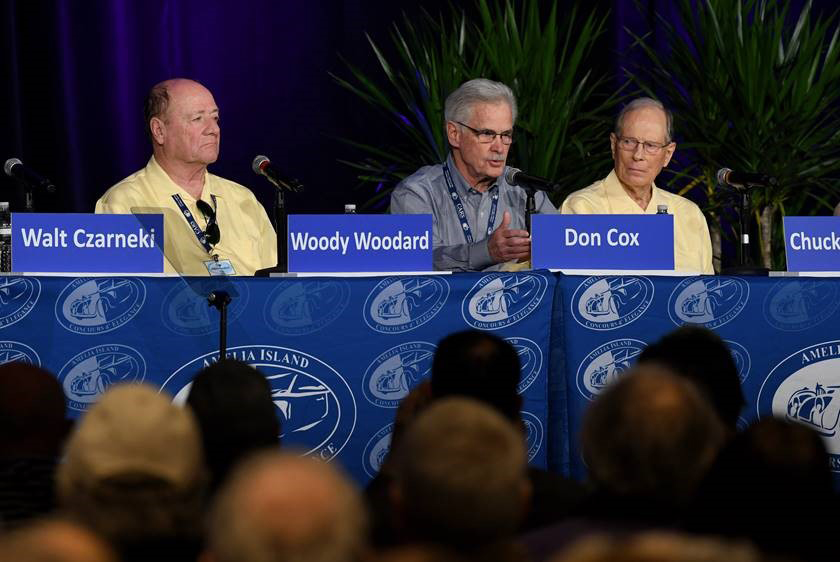
Don Cox (middle) explains his role spanning many years with The Captain at the sold-out, standing room only conference, “Team Penske – the Early Years”, in Amelia Island. Photo: Anthony J. Bristol
At this year’s Amelia Island Concours d’Elegance, in a seminar entitled “Team Penske: The Early Years,” Roger Penske waxed reminiscent about Cox in the discussion panel: “The TransAm was exciting, and Don, you really don’t give yourself the credit because you worked at General Motors and we needed someone in engineering to come with us and really change it. I remember, we took on the Javelin project because they offered us a terrific deal financially and to take our drivers and take on another challenge. Cox walked in the shop and the first thing he said was: “We’re going to put these brakes on this car.” Think about this, all these factory teams, Mustangs and Dodges, and Don came in and fitted these brakes. Now I wasn’t sure whether they were going to work but they gave us a competitive advantage from the standpoint of having the brakes that nobody else had. So those were early wins. And I think he’s probably modest.”
At the end of 1971, Penske was approached by Porsche to represent their marque in racing. What would prompt the Dr. Ing. h.c. F. Porsche AG factory to seek the services of The Captain? Strangely enough – a Ferrari. There was this Ferrari 512S, chassis #1040 which had been lightly used in the CanAm Challenge. It was then purchased by a used Ferrari dealer in Philadelphia – Kirk F. White. In an effort to promote his fledgling car dealership, White approached Penske hoping Penske Racing would borrow the car and use Donohue to race it. Penske eventually agreed. Team Penske did substantial improvements to the 512 and, with sponsorship from White and Sunoco, Donohue drove it to appreciable success. “The reason that program got started [with the Porsche 917-10 and 917-30] was the success we achieved with the Ferrari 512M, a car that was owned by a local guy in Philadelphia [White]. As I recall, we did four long-distance races, and three out of four times we out-qualified Porsche with that car. Porsche decided they wanted to get into Can-Am racing in the U.S. and they were looking for an American team to actually run their cars in America. Because we had done so well with the 512M, compared to them, our team was one of the people they considered.”
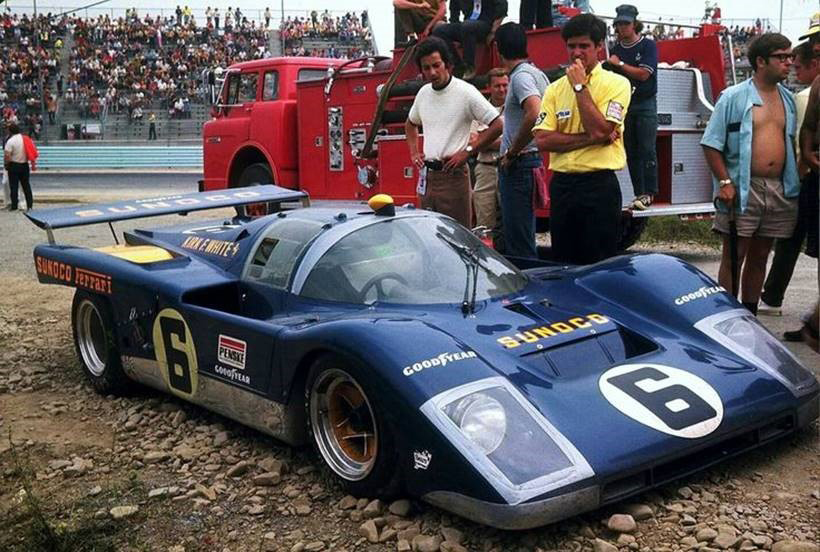
Don Cox (yellow shirt) ponders his next move to keep Penske Racing’s Ferrari 512 in front of the Porsches. Photo: Gilles Robert, Pinterest.
At the Amelia seminar, with The Captain sitting in the front row, Cox laid out the real story: “We [Penske, Donohue and Cox] ended up going to Germany to talk to them [Porsche] about putting that deal together. I don’t know if Roger knows some of this. During the trip, Roger told Mark and me, “Now, you guys keep your mouth shut. I don’t want you to screw up this deal.” He said, “I’m going to go make this deal with Porsche.” So Mark and I just looked at each other. And when we get there, they have all these test cars to drive, and they have all this stuff to show us, and it was really an informative session with their engineers. At one point I got Helmut Flegl off to one side; he was their engineer who was going to be the head of this project that Porsche had assigned him. So I asked him, “What kind of wing are you going to have on this thing, on this new Porsche?” He looked at me and he said, “Porsche thinks wings are for airplanes.” And…. end of conversation, because I didn’t want to screw up this deal.” Penske and the audience laughed in understanding.
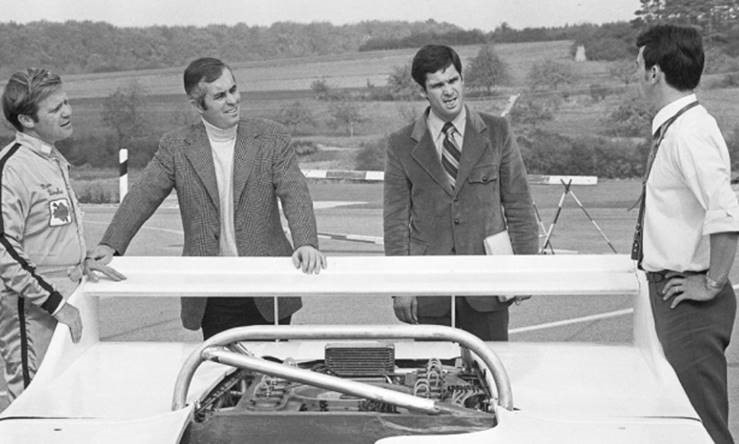
Donohue, Penske, Don Cox and Helmut Flegl at Weissach with normally aspirated test of 917/10 on that first trip to Germany. A much bigger wing was developed by Donohue and Penske. Photo: Porsche, Caption: Dean’s Garage
Cox continued explaining the saga: “Roger apparently made a deal so he said to me and Mark, “Okay, I think we got a deal.” So we got on a plane, Mark and I, to fly back to New York, and Roger went off somewhere else. All the way home, on the plane, we are talking and I said to Mark, “You know, I didn’t get a very good reception on that ‘what kind of wing are you going to have?’ thing. Now don’t forget the vacuum cleaner car [Chaparral 2J] was in existence in 1970. Anyway, I was thinking maybe they don’t want to do wings, maybe they got some other idea. Long story short, we didn’t even leave the airport in New York, we went back to Lufthansa and went back to Germany. We called Flegl and said, we have to have a meeting. So we had a meeting!” With a grin and a wink, Cox reveals – “Roger didn’t know this. We had a meeting with Flegl and he was a very, very bright guy, but he was new to motor racing, so we sat down and we explained everything about why have a wing, what it does, and it doesn’t matter that it has a little bit of drag, that you can sacrifice a little speed on the straightaway if you can gain significantly in the corners. And so you can see him coming right up to speed really quickly, and he said, “Okay, I will talk to the higher-ups.” About a week later we got a response on a Telex machine and it said ‘WE WILL HAVE WINGS.’ It all ended well, but it’s funny how it started.”
The Penske program for 917s was enormously successful. Starting with the L&M Cigarette liveried Porsche 917-10, Porsche earned their first CanAm Challenge Cup in 1972 with Donohue and George Follmer. Powered by the 5-liter air-cooled flat-12, the 917/10 was rated at 850 horsepower. That was a lot to handle even for the experienced Mark Donohue, who after an accident could not finish the season for the 1972 CanAm title. The white wedge became one of the most recognizable racecars in history.
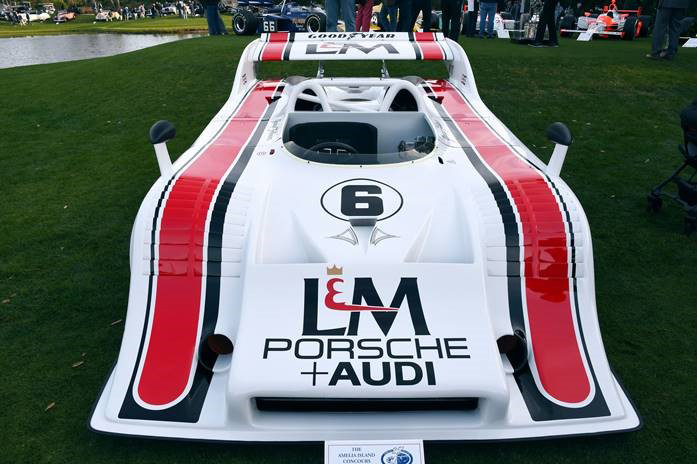
Porsche 917-10 K Serial 003, driven by Can-Am Champion George Follmer, dominated the ’72 Can-Am series taking 1st at 5 of 9 races Photo: Anthony J. Bristol
Then came “the beast.” Considered by some the most powerful racing car ever to set tire to pavement, the 1973 Porsche 917-30 towered above all. This was a reliable rocket with a turbocharged air-cooled flat-12 engine of prodigious capacity. Its power ranged between 1100 and 1580 horsepower which Donohue could adjust from the cockpit. Weighing a scant 1,800 pounds dry, this CanAm contender, in its world-renowned blue and gold Sunoco livery, could sprint from zero to 200 miles per hour in 10.9 seconds. Top speed is estimated at more than 260 miles per hour, but who would dare test the limits?
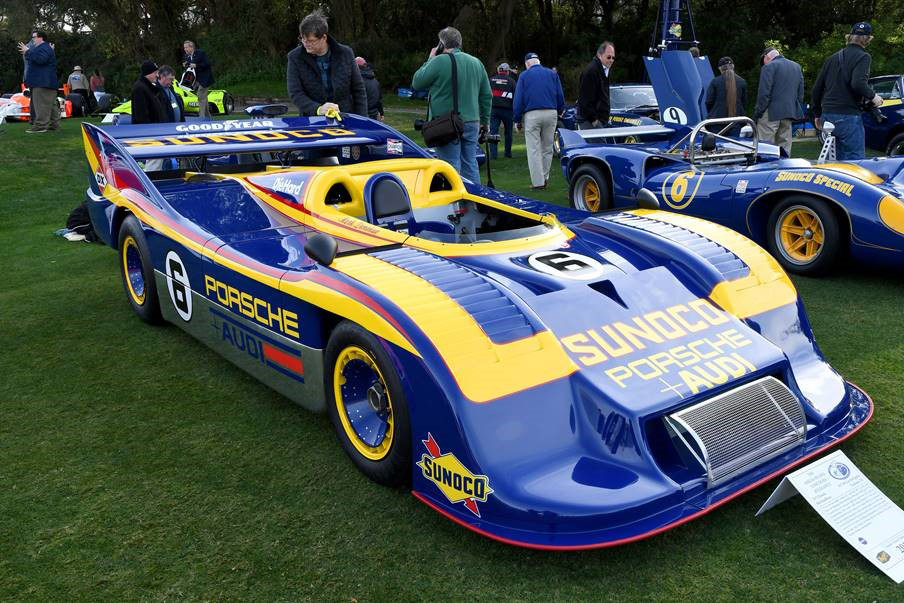
Mark Donohue’s Porsche 917-30, at Amelia Island Concours d’Elegance 2020. Donohue turned fastest closed-circuit lap in world history at Talladega Superspeedway, AL, average speed of 221.120 mph. on August 9, 1975. Photo: Luis A. Martínez
Cox’s first experience with Indy racing was in 1970 with Penske’s Lola T150, the #66 car. It finished in second place. Cox explains his involvement: “For 1971, Penske switched to McLaren. We wanted to be very involved in the design so we contracted to build the cars in England, designed by McLaren with Team Penske input. In 1971, Donohue won the Pocono 500 with that car. In 1972, I was the engineer with Donohue in the #66 car, the McLaren M16B, and on May 27 we won Roger’s first of an incredible string of Indy races.”
The Captain adds his touch to the Indy stories, “The air jacks, think about that. We brought air jacks to racing. Going to Indy and these guys with these hammers, and trying to get the wheels off, and these jacks, and it was a joke. Wasn’t it? We were a little too sophisticated! They called us the college boys, remember? With the crew hair cuts and the polished wheels and the yellow floors. That’s what our reputation was at Indy. Well, 18 races later I think some of those guys got their garages better.”
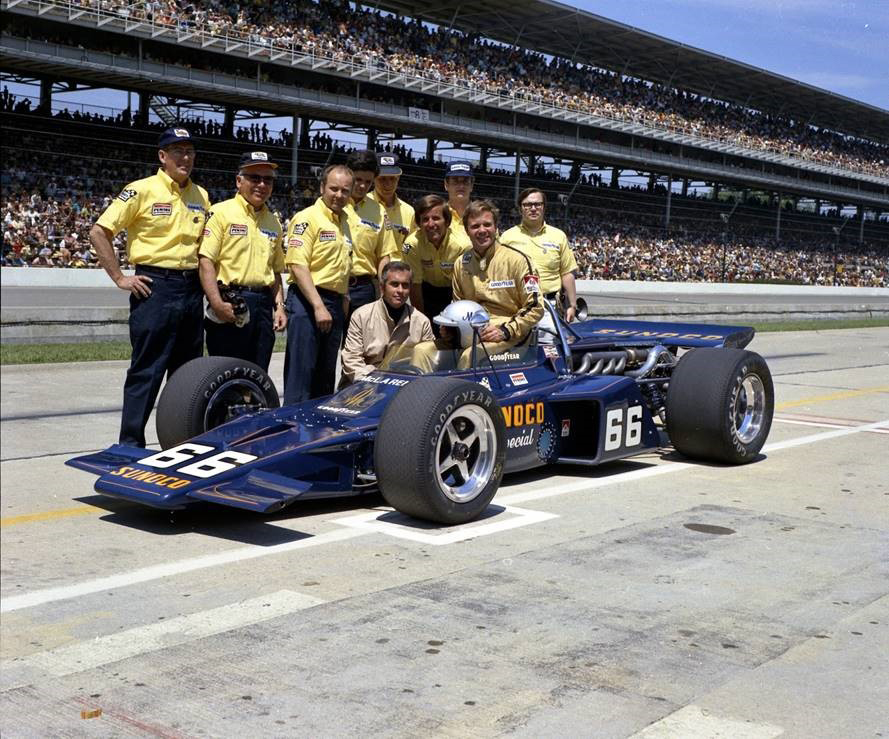
Roger Penske (kneeling) and the crew of Mark Donohue’s Sunoco McLaren in 1971. Don Cox is standing 4th from left. Photo: Indianapolis Motor Speedway photo.
The Captain has been building his reputation for decades, and it’s a lot more than crew cuts, yellow floors, and polished wheels. Here’s a point of view from an uninvolved racing fan named Bob Collins. Bob was attending college in Adrian, Michigan. One weekend in the spring of 1977 he was bored in his dorm room, so he went to Michigan International Speedway to watch race cars test and tune. Bob parked his 1975 Olds Cutlass at the steel gate of a service road and sat on the hood of his car to watch the action. A well-appointed late-model sedan approached the gate and the driver, seeing Bob, looked discomfited. The gentleman then asked Bob what he was doing there, pointing out that this was private property. Bob responded, “Well, I was in my dorm room, really bored, everyone is gone, so I came over here to see the cars. I love racing cars. I’m from upstate New York and I’ve been to races at Watkins Glen.” A brief conversation ensued, and unexpectedly the gentleman went and unlocked the gate and motioned to Bob that he could drive his Cutlass for one lap around the 2-mile D-shaped track. That gentleman could offer such a gesture, unthinkable today, because he owned the track – Mr. Roger Penske.
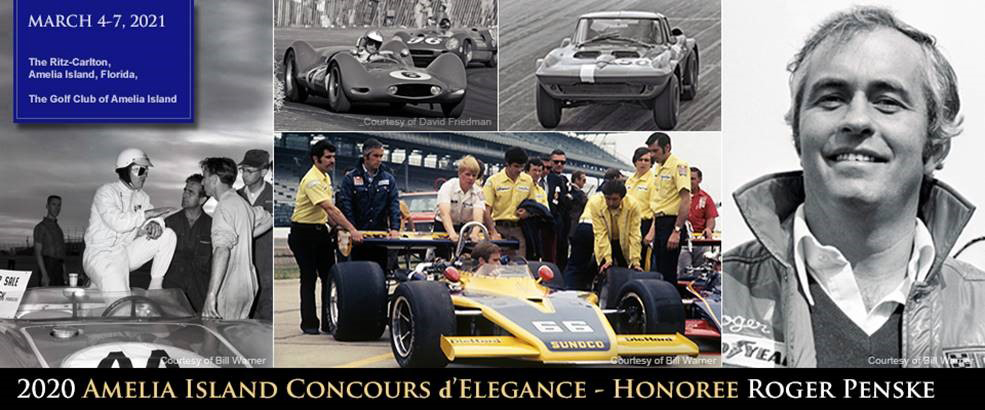
Bottom center color photo of 1973 Indianapolis 500, #66 car Penske Eagle/Offenhauser with Mark Donohue. Penske is second from left, Don Cox is 4th from left with jacket over his left arm. Photo: Bill Warner Archives
Cox maintained a full time working relationship with Penske for seven years. But it didn’t end there. “I left the race shop in ’76 after Mark Donohue died in Formula One practice at the Österreichring in 1975.” Cox relates, “But I kept working on projects and races with Roger until 1989, a total of 20 years. During my 20 year involvement with Penske Racing, I saw Penske accumulate seven Indy 500 wins.” Penske Racing went on to win an astounding total of 18 Indy 500s.
Today, still living in West Chester, Pennsylvania, Cox remarks on the many years with Penske: “Thinking back as far as my work on the Camaros, or the Javelin, or in Germany with Helmut Flegl and the 917, it all ended well – but it’s funny how it all started.”
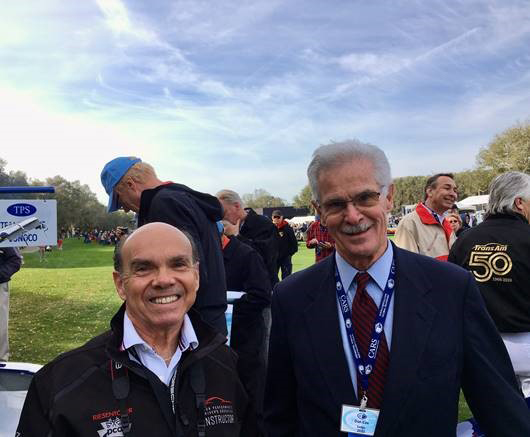
Author Luis Martinez and Don Cox at Amelia Island Concours, March 8, 2020. Photo: Anthony J. Bristol
Written by Luis Martinez
This story begins in 2011 when I was invited to work as a Staff Track Instructor at Monticello Motor Club (MMC), in Monticello, NY. But this story is not about me. It is about a group of very young and talented drivers who have clawed their way to podium finishes in competition against the world’s finest sports car racers.
During the six seasons I worked at Monticello I had the opportunity to meet many gifted young drivers. Who are these people that occupy mind share when I’m in places like Daytona, Watkins Glen or Sebring? Some who come to mind include Patrick Gallaher, Jason Lare, Corey Lewis, Stevan McAleer, Jason Rabe, Aurora Straus, Alex Wolenski and more. I find it remarkable that this car club has become a developmental platform, able to launch such a good group of drivers into professional racing ranks. Over the course of several years since I worked with them, these drivers have registered for races under various sanctioning bodies, including IMSA, Mazda MX-5 Cup, Continental Tire Challenge, Weathertech, Michelin Endurance Cup, Lamborghini Super Trofeo and others.
This year marks the 70th anniversary of the Twelve Hours of Sebring. The Sebring 12- Hours entry list for 2022 consisted of 53 cars in five categories. Replacing GTLM (factory-affiliated racers) this year is the GTPro. These are professional drivers in highly tuned but recognizable cars, some with factory assistance. There were 11 GTPro cars on the grid this year, including Acura NSX GT3, Aston Martin Vantage GT3, BMW M4 GT3 (2 entries), Corvette C8.R, Ferrari 488 GT3 Evo, Lamborghini Huracan GT3 Evo, Lexus RC F GT3, Mercedes Benz AMG GT3 Evo and Porsche 911 GT3.R (2 entries).
Another sports car class is the GT Daytona, which invites developing drivers – but many make a living racing and coaching racers – so it’s still a very select group. There were 17 GTD privateer entries piloting Acura NSX GT3, Aston Martin Vantage GT3, BMW M4 GT3, Ferrari 488 GT3 Evo, Lamborghini Huracan GT3 Evo, Lexus RC F GT3, McLaren 720S GT3, Mercedes Benz AMG GT3 Evo and Porsche 911 GT3.R. For marketing reasons, entries in the GTD category purposely retain visual characteristics as close to showroom stock as possible.
In total, 28 of the 53 entries were recognizable sports cars running in GTPro and GTD. The other 25 entries are never seen outside a racetrack.
Resembling spaceships – there were seven entries in Daytona Prototype International (DPi) powered by a Cadillac V-8, Acura V-6 or Mazda V-4 Turbo which can take them up to 200mph. The second class consisted of eight Le Mans Prototype 2 (LMP2) with similar weight, powered by a Gibson V-8 which lets them see about 190 mph. In the third tier there were 10 Le Mans Prototype 3 (LMP3) which can reach 180mph powered by a Nissan V-8. These closed cockpit cars are the most sophisticated closed-wheel racers in the IMSA series.
At this event, my focus was on three drivers that I worked with at Monticello – Pat Gallagher, Corey Lewis and Stevan McAleer. Responding to questions about their racing history to date, this is what they had to say about their journey to the top tiers of professional sports car racing.
In 2013, when he was only 20 years old, Patrick’s job at Monticello was Staff Track Instructor. One could reasonably ask – how can a 20-year-old be hired as Track Instructor at a venue where the members are wealthy – and much older than Pat? Ari Straus, CEO and Manager of Monticello Motor Club responded: “The nature of track instruction at Monticello is primarily to help with novice drivers. The benefit is that these same instructors also continue to coach and move club members and their guests from novice to solo, then to intermediate, and even to ‘gentleman racers’ who receive coaching services from our instructor team. As a result of our race coaching, Monticello has become the number one incubator for gentleman drivers at pro-level competition and reciprocally the number one organization for racing coaches to find opportunities to coach as they are surrounded by gentleman drivers.”
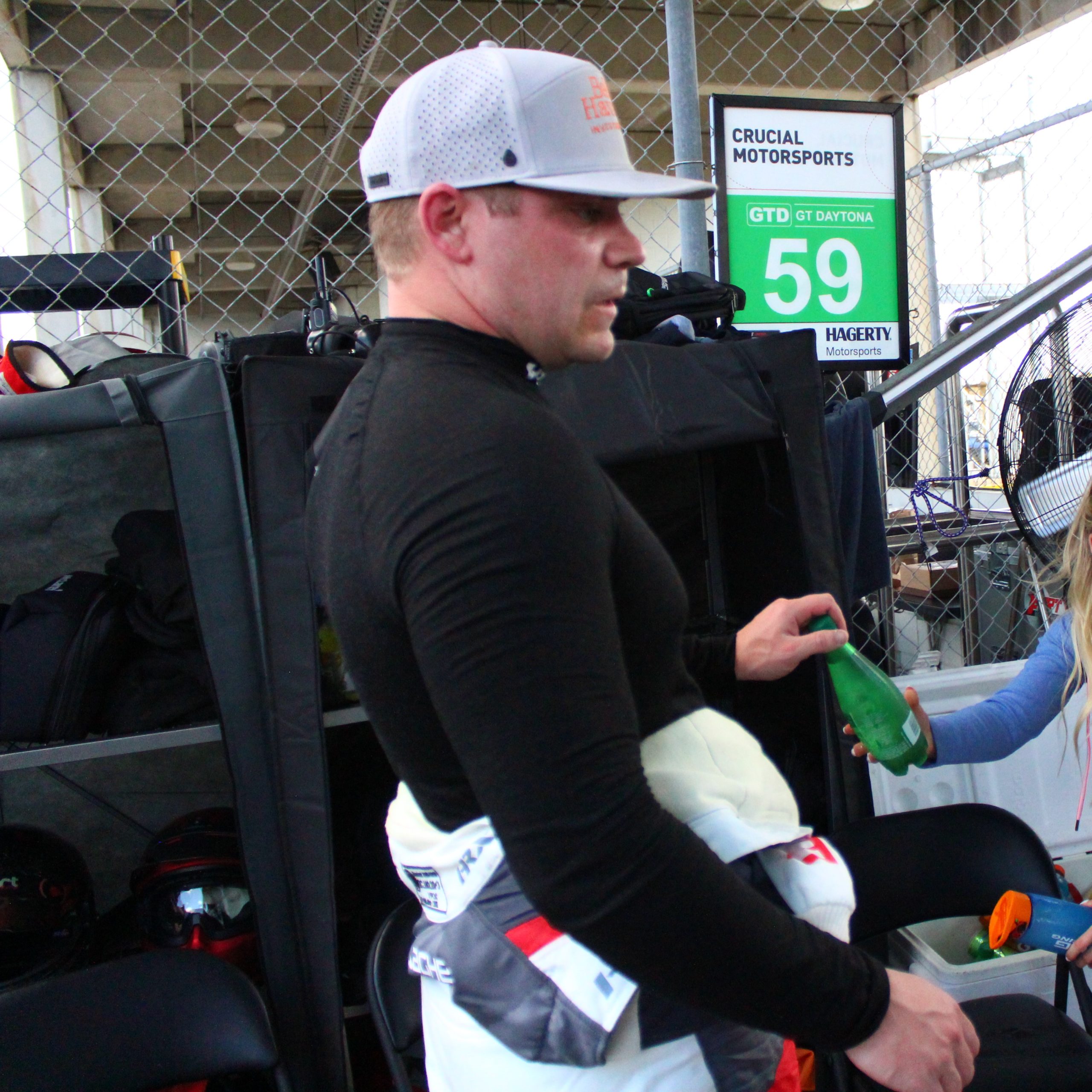
Patrick Gallagher after driving in the 12 Hours of Sebring.
Piloting the copper-colored McLaren 720S, the 59-car at The Bumps, Patrick Gallagher’s driving skills started to shine 15 years earlier in the Mid-State Ohio Kart Club where he won the 2007 Championship. Fast forward to 2022, Pat had notched a Mazda MX-5 Cup championship. He also won the IMSA Continental Tire Sportscar Series in a GT4 Ford Mustang for Multimatic Motorsports at Watkins Glen International. After co-driving a Ferrari 458 in a Historic Sportscar Racing event at Sebring in 2019, Pat was now in Sebring with co-drivers Jon Miller and Paul Holton in the Crucial Motorsports McLaren 720S GT3. Helping his passion for sports car racing, Patrick brings his degree in Industrial and Systems Engineering from Ohio State University to bear on the track.
Pat drove the same McLaren 720S at the Daytona 24 in January and now he was piloting at the Sebring 12, so how is that McLaren holding up? “The GT3 car has so much more grip and power, and it’s lighter [than a GT4 car] so it brakes better. Everything is turned up 20% better than a GT4 car. The McLaren is really good in the high-speed corners like Turn 1 at Sebring and the bus stop at Daytona. If your car’s strong suit is high-speed corners that’s where you have to attack.”
Endurance racing requires extraordinary stamina. To run a 2-hour stint, what levels of fitness are needed? Pat replies: “It’s like 140 [Fahrenheit] inside the car. I’ve been working with a trainer in North Carolina. It doesn’t make me any faster over a lap, but the fresher you are at the end when it’s 10 laps to go and it’s kill-time – you got to be ready to rock.”
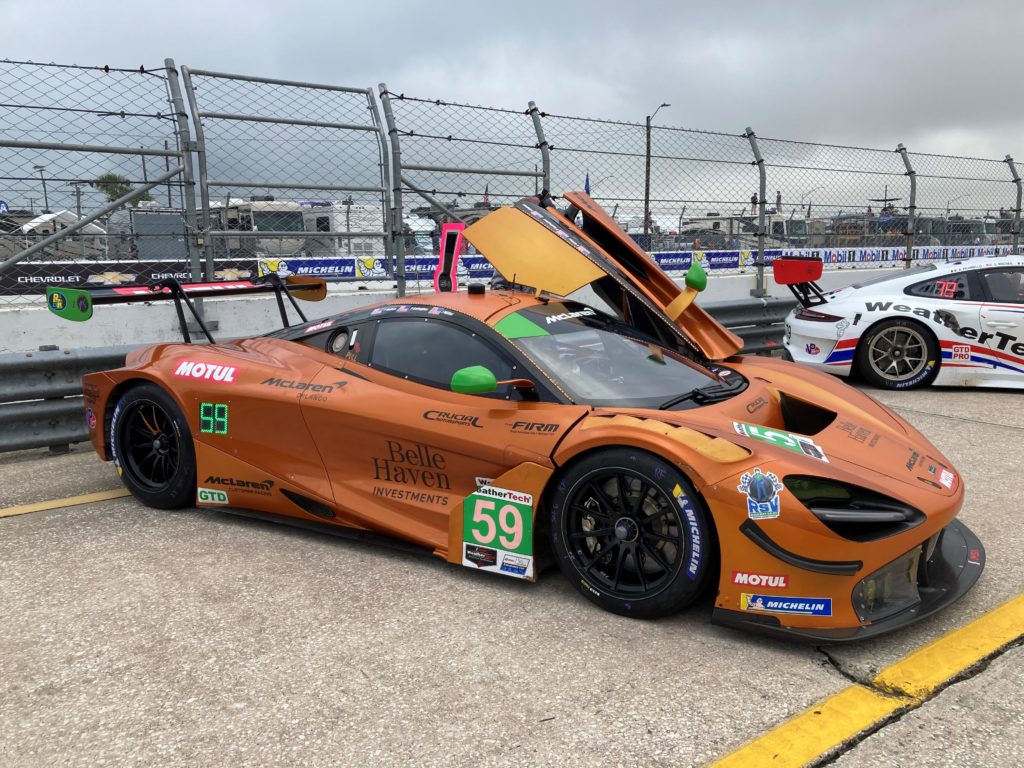
Patrick Gallagher’s #59 McLaren 720S GT3 at Sebring.
As Pat seeks to inspire younger men and women considering racing, he wants them to remember this: “I’m a racer, a real racer, my Dad was a racer, my grandfather was a racer. I grew up racing, that’s all I am doing.” Pat emphasizes the need to have an all-consuming affinity and focus in order to make it. “It’s a ladder system. I went through the Mazda Motorsports ladder system. I wouldn’t be where I was without them.” Pat lets readers know that it’s a small world in racing so it’s important to meet people. “I knew I could drive IMSA for a long time. It’s getting everyone else to believe it. I’ve known I could do that but getting yourself in that position [to be seen] is the hard part. I knew I could do it because I was racing some really, really good guys. When I started racing Michelin Pilot Challenge and you’re racing a lot of the same guys who are running in Weathertech in IMSA, when you’re in a GT4 car racing against those guys [in GT3, a higher class] and running up front, being super competitive – all I needed is to get a chance to get in the big show.”
What is Pat’s goal post at this point? “Winning at the Weathertech level is step number one. Winning the Rolex 24 [Hours of Daytona] is step number two. I want to check off all the big races – the Sebring 12 Hour, the Petit Le Mans, and then obviously a Weathertech championship.”
Does Pat have advice for young racers? “Ask yourself if you really, really, want to do it, and if the answer is yes, then do whatever it takes. You [Luis] saw how we lived when we were at the crash house [in Monticello]. It was the best time I never want to have again! Then you have to do better at making relationships. It’s relationships, relationships, relationships. If there’s a car that doesn’t have a driver, and they don’t know who you are then they’re not going to call you.”
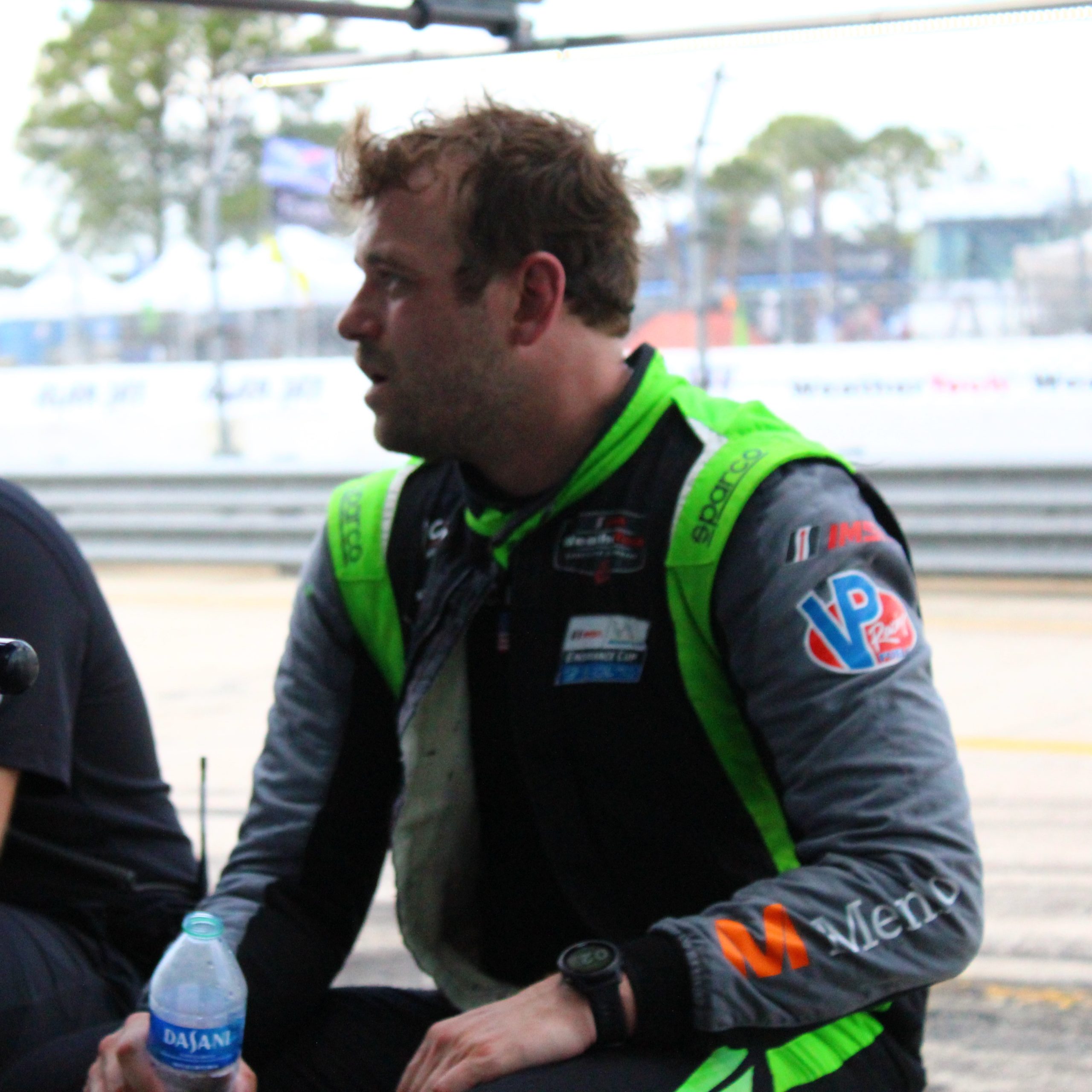
Corey Lewis cools off on a pit wall at Sebring
When we see kids playing basketball – what percentage of those kids will end up playing for the NBA? Corey Lewis explains how he rose from go-karts to the top threshold of professional sports car racing. Growing up in Nazareth, PA, as a teenager, Corey won the 2002 and 2003 Stars of Karting Regional Series Championship. In 2007 and 2008 he did exceptionally well in the Skip Barber Regional series, and then on to the Star Mazda Championship Series. At age 20, Corey began a stint as staff instructor at Monticello, where we met. Soon he was promoted to Senior Driving Instructor. Corey explains the importance of working at Monticello: “Ari Straus [CEO of Monticello Motor Club] had given me the opportunity to run in the Continental Tire Series. So that was my first taste of getting into IMSA sanctioned racing. From there, Joe Courtney had a Lamborghini Super Trofeo race car at Monticello, so he gave me the opportunity to drive it in the second half of 2014. Then in 2015, in my first full season in IMSA when I landed the Monster Energy Drink sponsorship, that’s when we won the Super Trofeo world championship and North American championship, both in 2015. In 2016, I made the jump into GTD with Change Racing, which was my first taste of the premier series in Weathertech. But if it wasn’t for working at Monticello, and meeting Joe Courtney, I don’t know if I would have ever had that opportunity to drive in the Trofeo series.”
Was having worked at Monticello a key ingredient for Corey’s progress? “Honestly, we all had the natural ability to drive the cars fast at Monticello. We were all learning. Monticello helped hone our driving skills and to go to the level where we were able to find those seats [in the professional series]. I had met Stevan [McAleer] at Skip Barber racing school when he came over from Scotland. At Monticello we trusted each other, helping each other out. At Monticello they gave us the opportunity to learn, to build, to meet the people that had the means to allow us to go racing.”
As a racetrack, did Monticello help or hinder driver development? “Monticello is a tricky track. The seven, eight years I was there driving all kinds of cars, from open wheel to street to formula, using different techniques with what each car does it all helped. I still use the tools of those days – thinking how the cars behave under different conditions.”
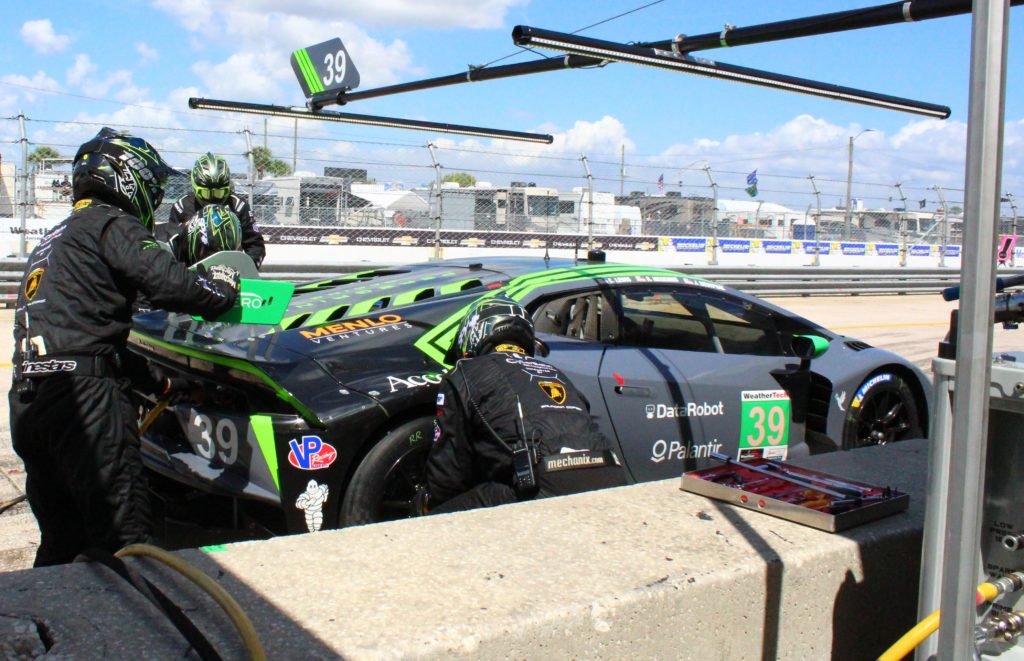
Corey Lewis’s #39 Lamborghini during a pit stop at Sebring.
Does Corey practice any fitness regimen for this sport? “Absolutely! It’s crucial. The biggest thing for me in racing is endurance, dealing with the heat. We don’t have A/C in our car [Lamborghini Huracan GT3 Evo], it’s an oven, 130-140 degrees inside the car. It’s just brutal. Plus the heat acclimation necessary from living up north in the winter and then it was 91 degrees and muggy in Sebring.”
What objectives does Corey have at this point in his career? “For me, I want to win some endurance races. I’d love to get the 6 Hours at Watkins Glen and Petit Le Mans. But the competition every year gets harder and harder because guys from overseas are wanting to race here, and if you can win you’ve done it against the best. I’d love to have a national full-blown season championship in GTD in the next couple of years. I’d love to race and win Le Mans, and in Spa in the next couple of years. I want to be the first American full-fledged factory Lamborghini driver.”
Does Corey have inspirational advice for young drivers? “I would say: you never know what tomorrow will bring. So persevere, try to be in the right place at the right time. Make the most of the opportunity. Get in the car, and bring it back in one piece. Have fun!”
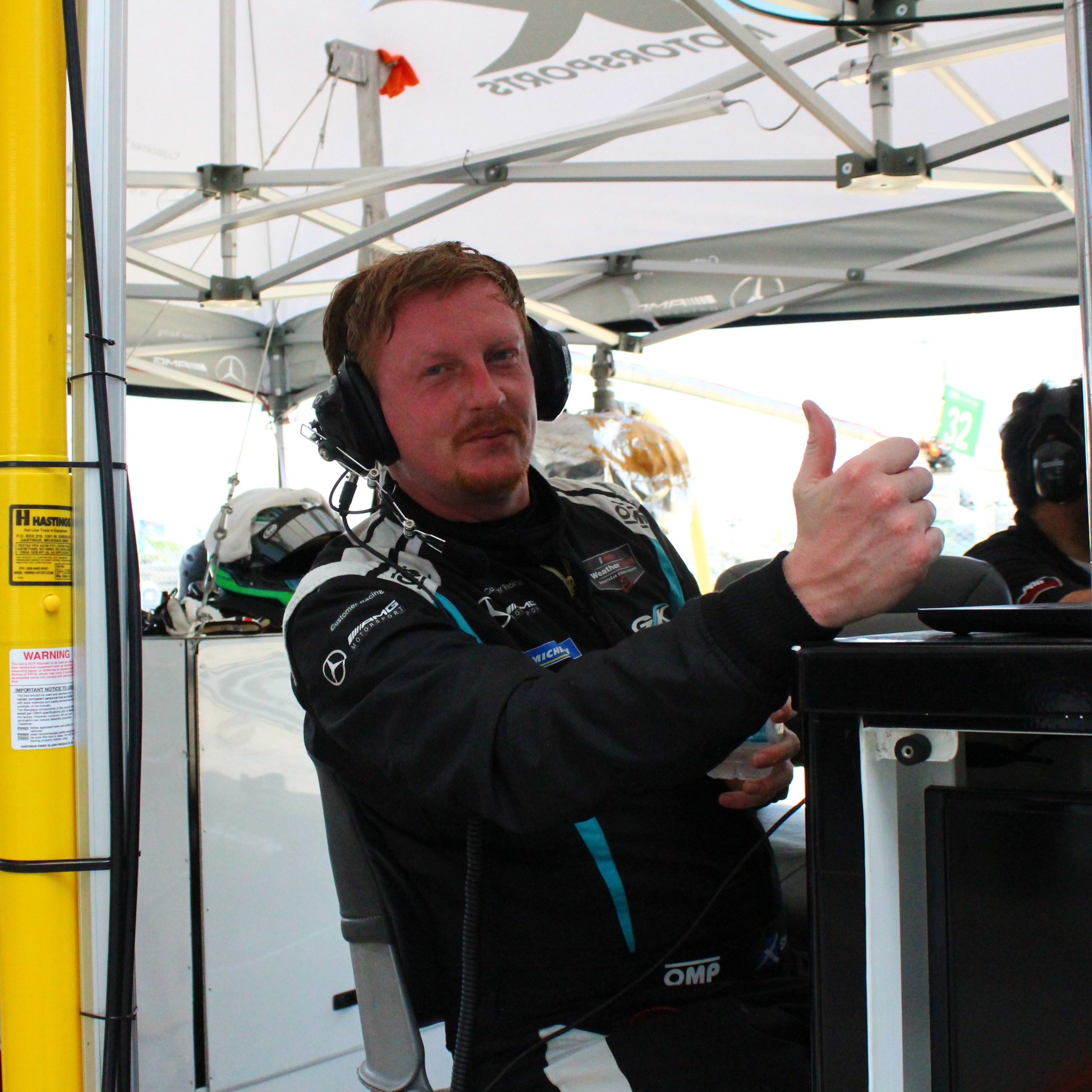
Stevan McAleer at the 12 Hours of Sebring.
Stevan McAleer also started with go-karts – in rainy Scotland. Stevan shares his memories: “My Dad was big into racing, with a 1.2 Liter Ford. It was the smell of the fuel and the tires squealing with guys coming around corners – you could tell who could drive and who was crazy. Dad gave me a go-kart when I was 11.”
Was it all wine and roses getting started? “In the beginning I was not good at racing karts, finishing way in the back. But then [after an accident] my Dad entered me in a race, a Juniors race, and I won. So that was the beginning and here we are.”
What came after karting? “To get into IMSA, first I went to Mazda; I did the Mazda MX-5 Cup in 2012 and I won the championship. During those times, the season champion would get a full season in Continental Tire Series in Street Tuner class with a choice of teams – and $200,000. I chose CJ Wilson racing. I told them, your cars need development and we’re going to win races. We made a lot of setup changes, a lot of data management. I won my first time out at COTA [Circuit of the Americas]. Then three years later we won the championship in 2015. That’s how I got to Continental.”
Is there a special magic at Monticello? “At Monticello, like in any sport, people see the highs. What people miss on the backside are the long days, the tough times when you feel you’re not catching a break. At Monticello, as an Instructor, the more coaching I’ve done, the more I continued learning, when a car is not working right that has got me in a position where I can adapt to anything. I’m driving six or seven different cars so when something is not right I have to fix it. That helps my progression as a driver. Being in the seat as much as I can, just talking to someone in the intercom [between helmets], I’m still working even in the right seat [as a racing coach].”
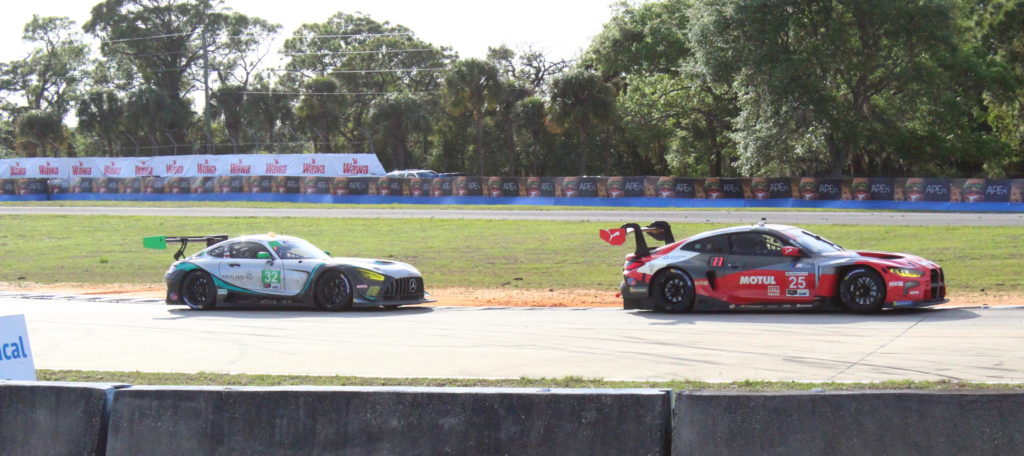
Stevan McAleer’s #32 Mercedes chases the #25 BMW M4 in Turn 7 at Sebring.
Those LMP3’s – what’s it like racing those rockets? “LMP3 are prototype carbon fiber cars with 450hp from a Nissan big 341 cubic inch V8. I’ve been in everything – the Porsche GT4, the BMW GT4, the Mercedes GT3 car – and the reason I’m able to do that is I do drive a lot of different cars. I am asked to put in a reference lap for a team and then I bring it back [in one piece].”
What are some objectives that Stevan has for his racing career? “I want to win the Rolex 24, like in the Mercedes GTD. But most of all I want to win the championship. Winning championships shows a driver has it all. You can win races by being fast, but if you’re fast and reckless you can’t win the championship. I wanted to be in the big show, IMSA, and here we are leading the championship [as of this writing]!”
How would Stevan inspire younger drivers? “The road to racing is so hard, and you have to work for a seat. If others have significant money to support them, then they can buy a seat, so you have to work so you can ask for a salary, [a distinct disadvantage] when others are putting up their own money. But my goal is to make my [coaching] clients better drivers, faster and safer. I’m looking after the client’s best interests.”
Known as “The Bumps,” there is something visceral, loud, in-your-face about Sebring Raceway. Racing fans can get close enough to the racers to feel the pulsations of their engines and hear the tires struggling for grip. The ghosts of racers past must come back to visit, watch and marvel at these Three Guys from Monticello.
by Luis Martinez
After trying to promote formula cars on ovals for its first couple of years, IMSA decided to switch its show to Grand Touring (GT) cars in 1971. The first IMSA GT race, the Danville 300, took place at Virginia International Raceway (VIR) on April 18, 1971. One of the avid spectators at the inaugural event was a U.S. Army Commanding Officer from Fort Lee, VA. The C.O. enjoyed that Sunday’s 3-hour race and the next day the Fort Lee Army Base newspaper, Fort Lee Traveller, announced the results. The C.O. discovered that one of the winning drivers of the #59 Brumos Porsche-Audi that not only won the GTU class but finished first overall was an Army conscript in his command – Army Specialist 4th Class Harris “Hurley” Haywood. Curious about this remarkable find, he summoned Haywood to present himself. When informed that he had been called, Haywood exclaimed, “Oh, (bleep)!”. Did Haywood, an active serviceman and Vietnam veteran, ask for leave to register as co-driver with racing veteran Peter Gregg? The rising IMSA Co-Champion replied with a grin: “I didn’t really ask for leave, I just sort of went.” Twenty-two year old Haywood went and chatted with his superior about the race. The C.O., realizing the talent and potential that Haywood exhibited during the race, comforted his conscript: “We have to accelerate your process-out paperwork!” How’s that for the quick application of a racing term to Army protocols?
One may ask, how did Haywood progress so quickly in life to run in front of the field for a win at the inaugural IMSA GT race? Two salient factors were in play: Haywood’s driving talent (schooled on his grandmother’s farm in Illinois), and an observant, experienced racer who recognized that talent and hired him. Haywood had often stayed at his grandmother’s farm. While there, he drove farm equipment and cars on private land learning handling techniques and getting a wheel ahead of his suburban peers. Meantime, Peter Gregg, a Harvard graduate and Navy Intelligence officer eight years Haywood’s senior, had become a successful Porsche racer. Having built an admirable racing portfolio in the middle of the 1960s, Gregg purchased an automobile dealership in Jacksonville, Florida in 1965, from Hubert Brundage – Brundage Motors. The cable address for this dealership was BRUMOS.
In the late 60’s Haywood was at college in Florida and had bought a used Corvette to compete at local autocross events. At one particular event, the experienced racer, Gregg, was also participating but the younger Haywood beat him anyway. Gregg normally won everything he entered so he decided to meet the talented youth. A friendship then ensued, a partnership that began with Gregg and Haywood collaborating to drive in the Six-Hour International Championship of Makes at Watkins Glen in 1969, winning the GT 2.0 class in Haywood’s orange #58 Porsche 911S.
But then war intervened. Haywood’s draft number came up for compulsory military service. He served a tour of duty in Can Tho, south of Saigon. While serving in Vietnam, Haywood learned a lot about situational awareness – constantly adjusting to unrelenting change while literally dodging bullets. These are lessons that he carried to podium finishes for decades as a highly successful endurance race driver.
In its inaugural year, IMSA’s classification of GTU was aligned with FIA Group 2 regulations for grand touring-type cars with engines of 2.5L displacement or less (the letter U referring to “under”). With so many cars to choose from, why choose the 914-6 for 1971? Haywood responds: “The 914 GT was a ton of fun to drive. The engine is just under 2.5 liters rated at 242 hp with two Weber triple-throat carburetors. It’s caged to stiffen the chassis, and Peter drilled holes in the door panels to lighten it. It had a dry weight of 2,098 lbs with a racing suspension, a 5-speed manual transmission, and 911-type calipers. Rear tires are oversized and fit in the enlarged, squared-off wheel wells. The tires were Goodyear, 7.5 inches in front and 8.5 rear, on 15-inch wheels. With a stock capacity 16.4 gal. gas tank, the car ran in GTU. In the race, the big bore cars would run from me but I would stay on them. Going into the corners I could brake better and eventually just wore them out. It’s a giant killer.” The 914-6 had arrived from the factory as a body in white. Brumos points out that orange tangerine was Dr. Porsche’s favorite color and to pay tribute Peter Gregg chose it for his race car’s livery.
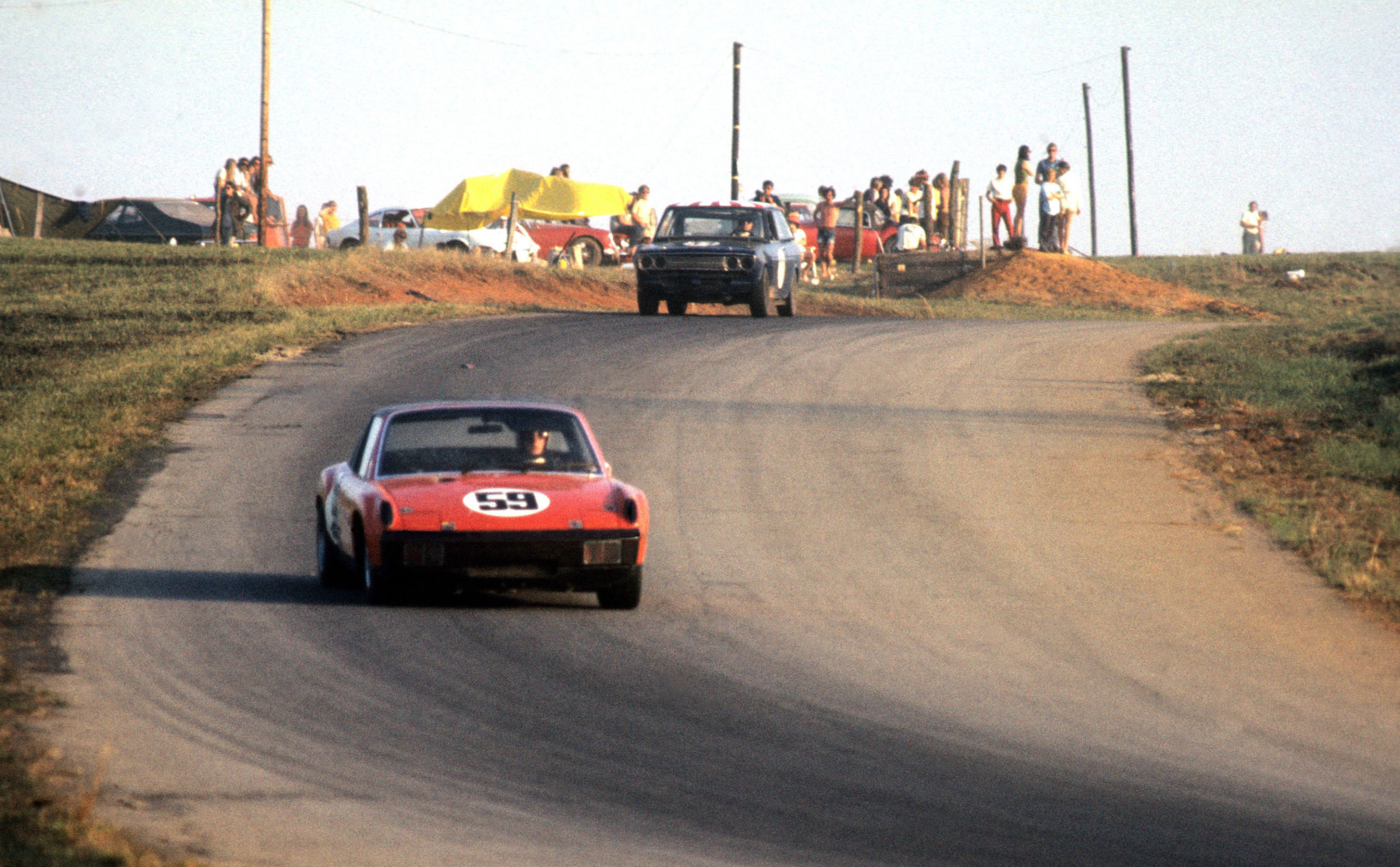
The Brumos Porsche 914-6 is seen approaching the Hog Pen corner at VIR in 1971. It was the overall winner of the first IMSA GT event ever held, beating out Dave Heinz’s more powerful Corvette in the process. Photo: Bill Oursler
The Danville 300 was actually Haywood’s third race of the 1971 season. He had already run with Gregg in the 24 Hours of Daytona where they qualified the same 914-6 in P1 but DNF’d on lap 260. A few weeks later they took the #59 car to the 12 Hours of Sebring and again qualified P1 in class and finished second in class. Haywood explains in his book, Hurley – From the Beginning, the crescendo of excitement that resulted from the win at the Danville 300: “We put the car on pole position for the class, this time starting on the front row with Dave Heinz and his 427 Corvette. That got some attention. Though the Corvette was fast and powerful, it was also heavier, with less braking power. When it started raining during the race, I found my groove and the 914 was amazing. I loved driving in the rain, especially in the perfectly balanced little car. By the end of the race we were a lap ahead in first overall, and it hit all the local papers including the Fort Lee base paper with a big photo of me on the front page.”
The car/driver combination of Porsche 914-6 GT and Gregg/Haywood proved unbeatable in IMSA GT’s first year: “ I actually owned that car when we raced it. After VIR we then went on to win our class several more times that year (Talladega, Charlotte, Bridgehampton and Summit Point) so Peter and I were co-Champions in ’71. We didn’t even bother running the 914-6 in the last race (Daytona) in November.” Haywood ran that race in a Porsche 911T.
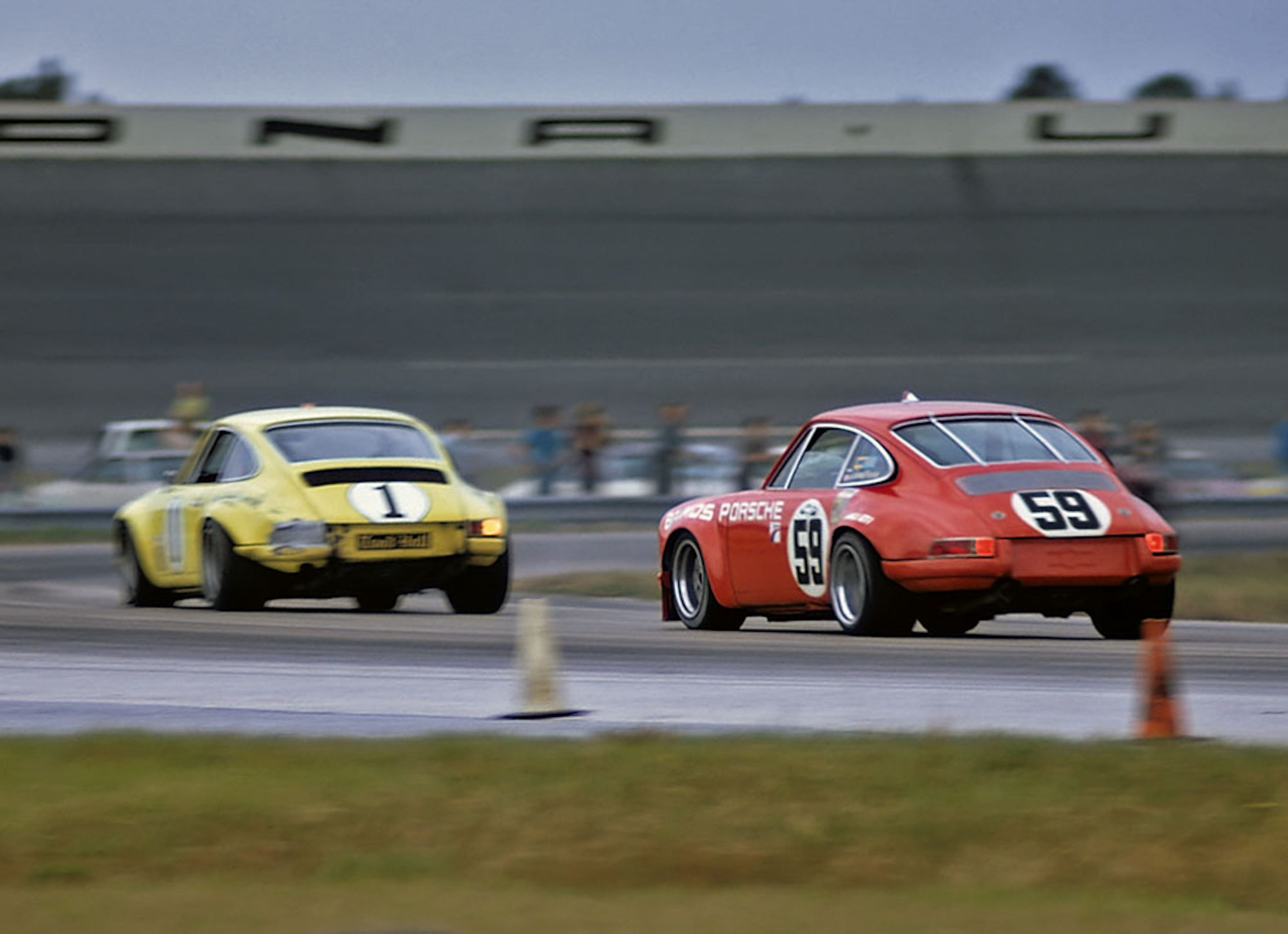
Haywood and Gregg shared a Porsche 911S in traditional early Brumos orange at Daytona in November 1971. The car is seen here following Michal Keyser in a similar car through the infield section of the track. Photo: Bill Oursler
Haywood acknowledges in his book the positive impact that his tour of duty in Vietnam had afforded him: “The Army had changed me in ways I couldn’t have predicted. I was a calmer, more confident, cooler young man than that kid who drove at Watkins Glen in 1969. In terms of the racing itself, it was as if I never left. Instead of being rusty, my senses were sharper, my concentration more finely tuned.”
This observation about the success potential with Porsche as the ‘giant-killer’ among big-bore turned into a significant trend – from 1970 through 1984, the Porsche 917’s and other racing models accounted for 21 of the 26 overall victories in the two Florida classics – the 24 Hours of Daytona and the Sebring 12 Hours. “The 911 RSR was – and is – a great car to drive,” said Haywood, who scored three of his five overall Daytona 24-hour victories in that production-based car. “Back then, it was the car to drive because of its reliability. It was a really strong car, while the competition was not quite as reliable. The Porsche was not necessarily the fastest car on the race track, but it was certainly the most reliable.” That should settle the choice – should one go for sizzling raw power or boring reliability? Haywood is the living truth of an old saw – to finish first, you must first finish.
What happened after 1971? Haywood responds: “The 914-6 was sold and for a long time I lost track of it. I sold it to the Mexican Formula 1 racing driver, Héctor Alonso Rebaque.”
In 1972 John Bishop, co-founder of IMSA, secured a major sponsorship – R.J. Reynolds Tobacco Co., which put its Camel cigarette brand on the organization’s top series. As the title sponsor, the series became known as the Camel GT Challenge. Haywood remained on the roster for Brumos: “In 1972 I was given the job to run the GT car, a 911, #59 in Brumos livery and I won the championship outright.”
Over the years, the teamwork became well known, “Peter and I did so many races together, they called us Batman and Robin. We were virtually unbeatable in any car – the 914, the Carerra RSR, and the 935’s”. The driving duo lasted through the 1970s. “We had had an agreement that I would always race at least one race with Peter each year. We ran one or two races in 1979” until Gregg’s untimely death in 1980.
Besides the Danville 300 inaugural that Haywood vividly remembers, it was just two years later that ‘Batman and Robin’ registered for what became an epic race – the 1973 24 Hours of Daytona. It was in this race that the ‘dynamic duo’ unknowingly became the Porsche factory racing team. The factory had assigned two identical Porsche Carrera RSRs, which were effectively a prototype for the RSR still in development – one to Roger Penske’s team and the other to Gregg’s Brumos team. Gregg dismatled the car and noted that the flywheel was loose. He passed the information on to the Penske team but they failed to act on it. This proved to be a fatal error; Penske’s engine decomposed during the race and they DNF’d. Noting Penske’s failure Norbert Singer, then in charge of Porsche’s racing development, and his factory entourage came running to the Brumos pits which then took the mantle of ‘factory team.’ Singer then directed Gregg to tell Haywood to “slow down.” Haywood gave it only nodding attention – he had other problems – a seagull had penetrated Haywood’s windshield – literally. He needed to pit but they didn’t have a new windshield. The crew desperately “sourced” one from a spectator’s car. After the successful pit stop Haywood finished first overall. Because of that finish, the team handed the Dr. Ing. h.c. F. Porsche AG factory its first international race victory using a Porsche Carrera RSR.
A single-spaced resume listing the interminable racing accomplishments by Haywood would be much longer than this article. Some of the highlights include wins at five 24 Hours of Daytona, three 24 Hours of Le Mans, two 12 Hours of Sebring, two IMSA GT championships, and one Trans-Am championship. Incredibly, Haywood started at the 24 Hours of Daytona a total of forty (40!) times by the time he retired in 2012.
Hurley Haywood at a Grand-Am event at Watkins Glen in 2010. Photo: Luis A. Martinez
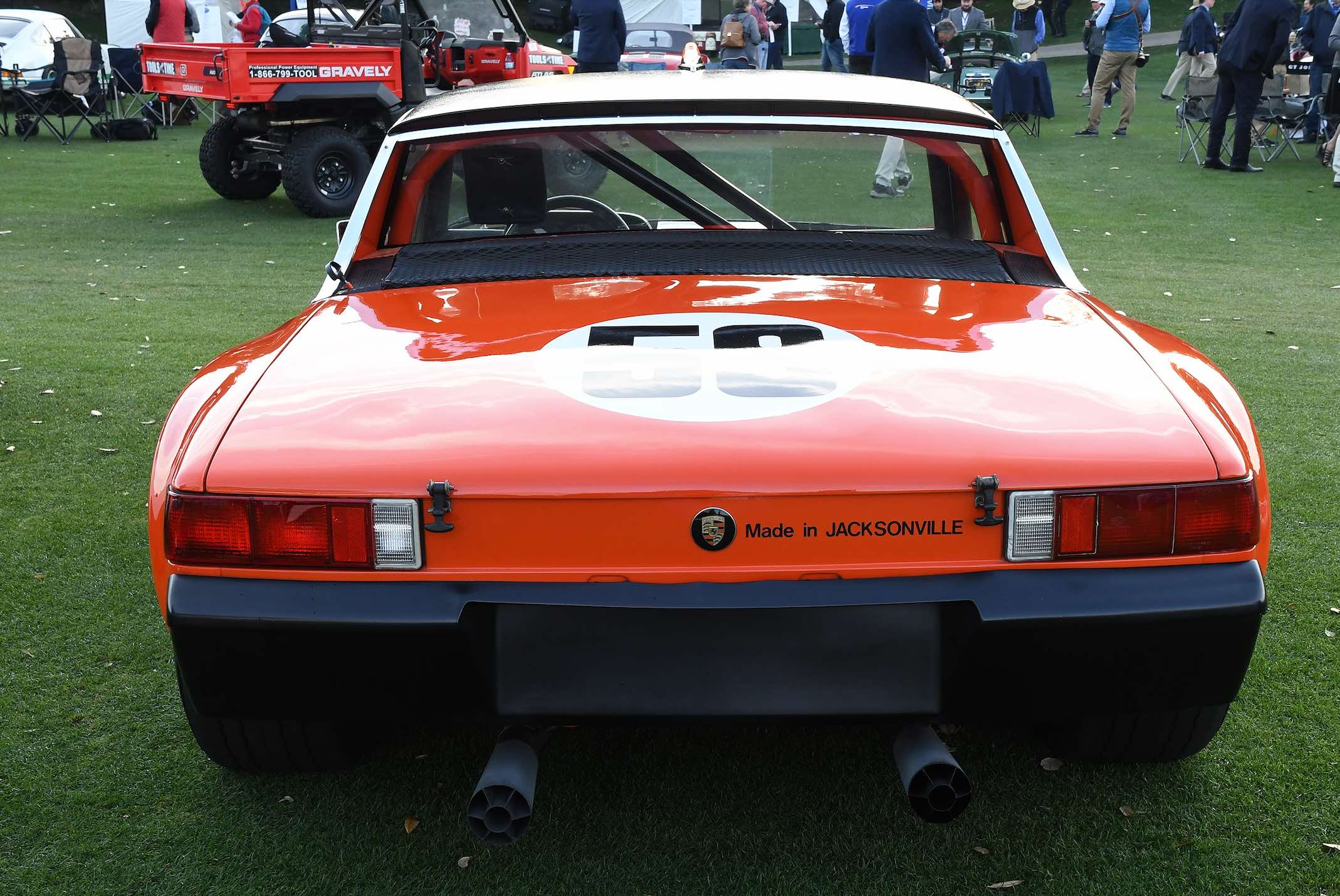
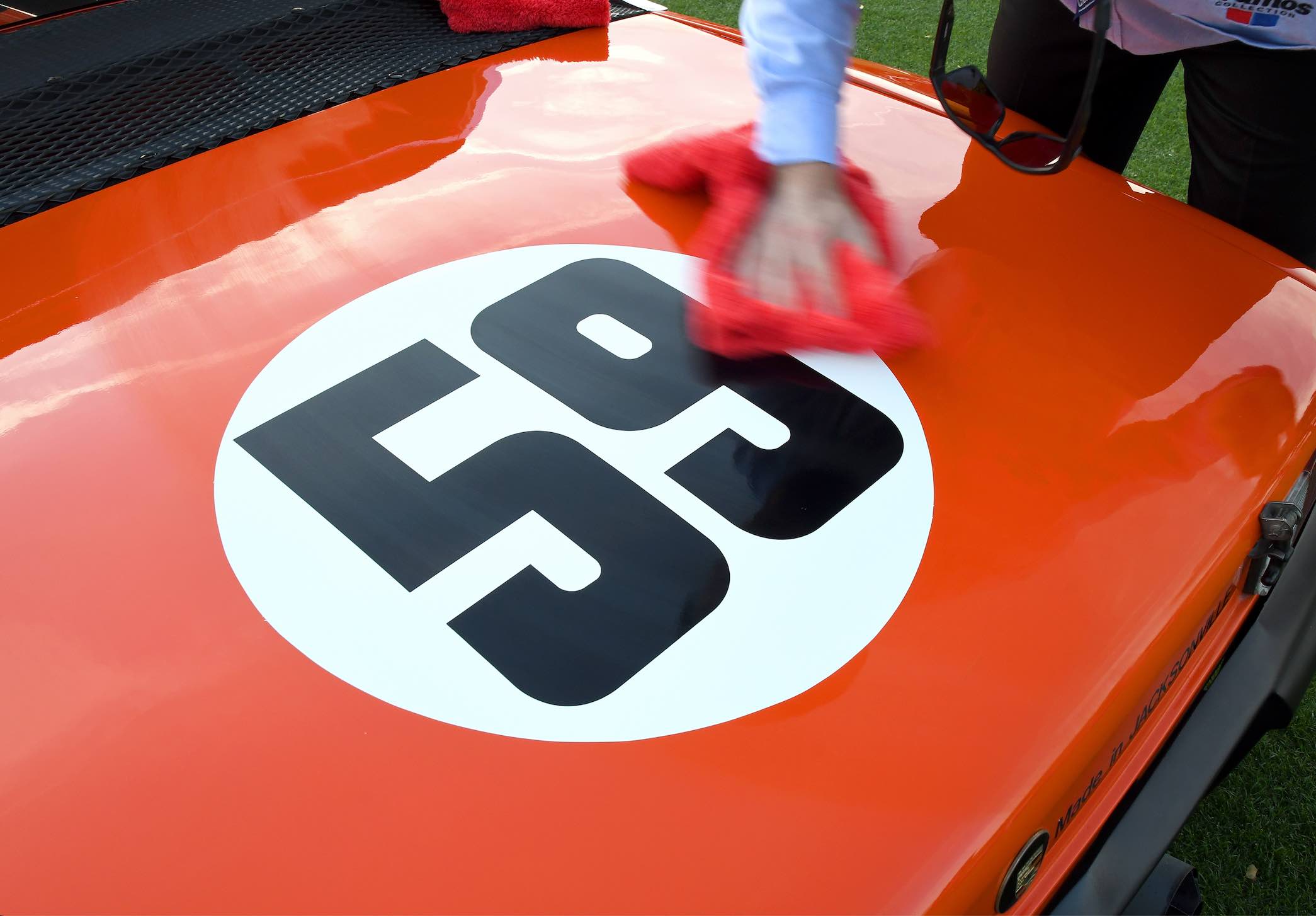
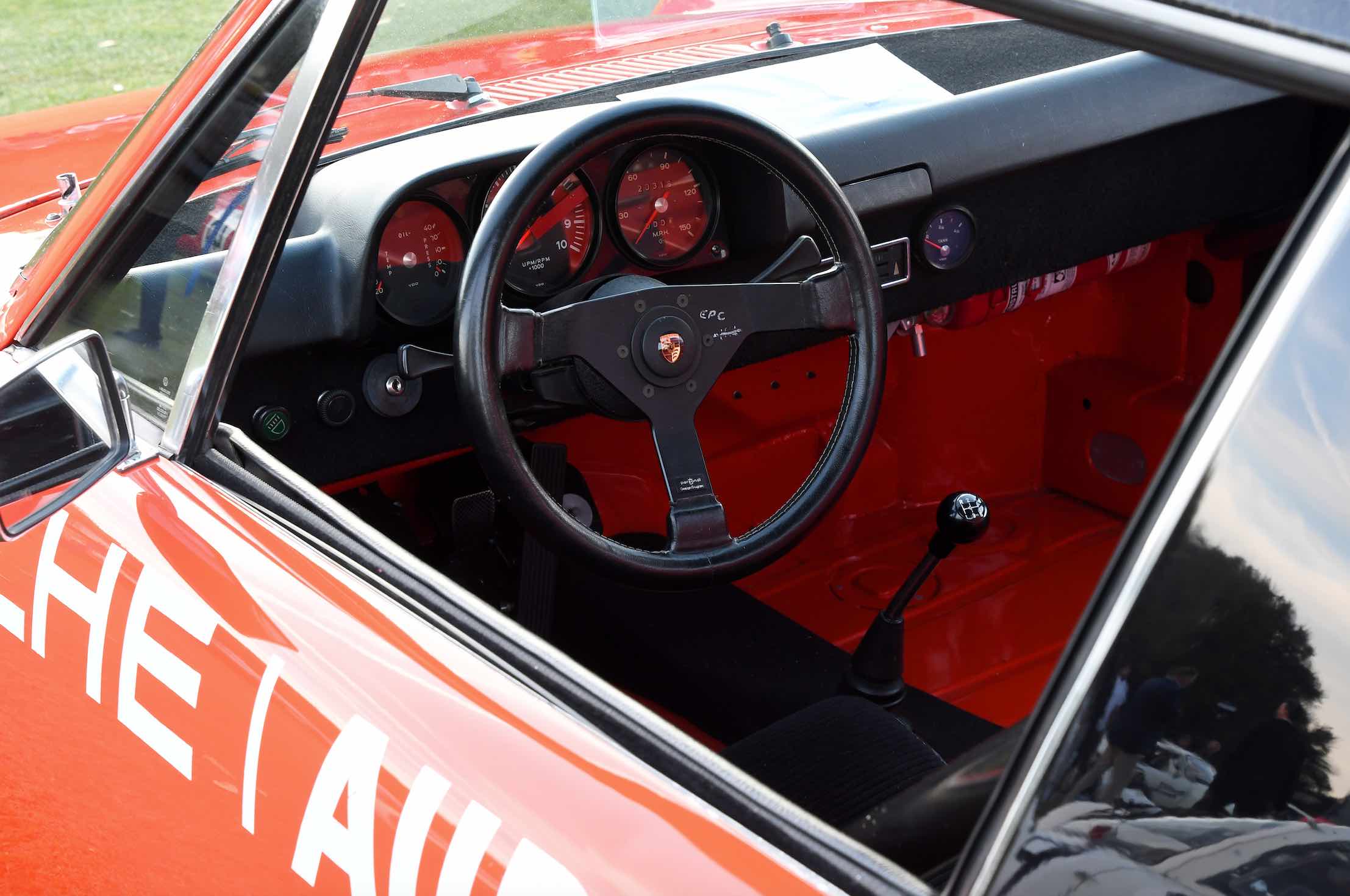
But what happened to the #59 car, the tangerine orange Porsche 914-6 GT? “After I sold it to Rebaque’s father I lost track of it. Someone found it years later in 1988 in a field in Mexico. There are many 914’s out there but they called us about it. We sent our crew chief to confirm and we were able to positively identify it because Peter and I had drilled the door braces to lighten the car.” The Brumos team has meticulously restored the #59 car to its original specs and it now resides with the Brumos Collection in Jacksonville, FL.
Recent photos of the restored Brumos Porsche 914-6 at Amelia Island (photo credits: Anthony J. Bristol):
– Luis A. Martinez
By Luis A. Martinez
I was casually leafing through a recent copy of the Porsche Magazine, Christophorus, (March 1998), when a number of splendid black and white photographs of road racing cars of the 50’s and 60’s caught my attention. Somehow it is appropriate that photographs of cars of that era be black and white; color would be totally superfluous, even distracting. Staring at the photographs I am immersed in the facial expressions of the drivers who betray, in their open face helmets with goggles, their intense concentration and total commitment to their work. Today’s closed-face helmets add a significant safety margin, but, alas, photographer and spectator alike are deprived of contact with the drivers. Among the many iconic cars presented in this story are early Porsches – RS Spyders, RSK’s, 550’s – driven by the likes of Masten Gregory, Jo Bonnier and Ricardo Rodriguez.
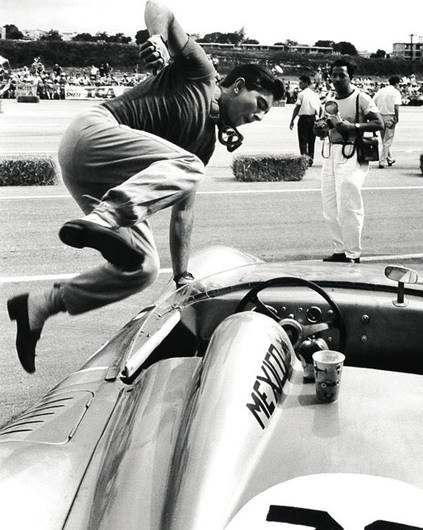
Ricardo Rodriguez practices a Le Mans start in his #39 Porsche 1600 RSK just prior to the 1960 Grand Prix held in Havana, Cuba. Photo: Tom Burnside, from the collection of The Revs Institute, copyright www.santens.co.
The featured photographer is Tom Burnside, who traveled the road racing circuits from 1954 to 1968, capturing the essence of sports car racing in those early years after World War II. On page 36 of Christophorus I study Ricardo Rodriguez, caught by Burnside’s lens as Rodriguez leaps over the door into his Porsche 1600 RSK practicing the traditional Le Mans start in 1960. Rodriguez is wearing a short-sleeved golf shirt, goggles dangling around his neck, driving gloves without fingers (like today’s bicycling gloves), and – not to be missed above his penny loafers – his pants legs gathered up around his ankles under small belts to keep his pant cuffs from interfering with the furious pedal work that lies ahead. I know Mexicans are very proud of their motherland, so Rodriguez uses electrical tape to write MEXICO in block letters on the faring behind his head restraint.
Then I glance over at page 37 and I can’t believe my eyes – a photograph of road racing cars in the 1960 Havana Grand Prix! It is obvious in the photograph that the race is being run on the wide-open spaces of a runway, and then I shudder as goose bumps course up and down my spine. I WAS THERE! It’s the first time I’ve seen a photograph of that event, which took place on the Columbia Military Airport in suburban Havana in early 1960. I was born in Havana, and it so happened that we had our home on 21st Avenue, between 82nd and 84th streets. The military airport, which was the venue for this race, was at the south end of 84th street, only one block from my house. As a young child, oftentimes I would run up to the fence to see bombers, propeller fighters, venerable DC3’s and assorted aircraft warming their radial piston engines at the eastern end of the runway (visible at the far end in Burnside’s photograph). My favorite airplane was the Lockheed Super G Constellation, an early 1950’s transatlantic carrier with its unmistakable triple vertical stabilizer and four piston engines of 9,000 combined horsepower. Its crew would carefully warm up one engine at a time, and I would wait patiently, staring through the cyclone fence at the monster about 200 yards away. The pilot would hold the brakes, rev up all that horsepower until the window glass on our houses shook, and then release the brakes, beginning the takeoff roll, headed to parts unknown. Like some annoying song that sticks in your head, the roar of those engines is still in my ears.
But how did this Grand Prix race come about? The late Joel E. Finn, the author of the prized book, Caribbean Capers, wrote that “Kenneth ‘Ken’ Coleman of West Palm Beach, FL, had been involved in road racing for some years as an active member of the Florida Region of the SCCA.” Flinn indicates that it was Coleman who approached the new Director of the Cuban Sporting Commission, Captain Felipe Guerra Matos (“Guerrita” to his friends) and convinced him that organizing a sports car race would entice tourists from the US, whose numbers had plummeted. I personally remember the gentleman, Guerrita because my mother’s younger sister, Edith Romagosa, was his Executive Secretary. This explains why my Dad and I had unfettered access to that Grand Epreuve.
Finn goes on to explain that Guerrita accepted Coleman’s proposal and allowed Coleman and two other Cubans with racing experience, Juan Garcia and Alfonso Gomez Mena to coordinate the Havana Speed Week. After concluding that the seaside boulevard, “El Malecon”, the venue used in previous races, was unsafe and uncontrollable. (In a personal conversation I had with the late Phil Hill when I asked him which was the most difficult track he had ever experienced he said El Malecon in Havana because sea water is constantly washing over the wall onto the street and creating a soapy scum on the pavement). For a venue, Coleman’s team chose the military airport, Campo Libertad (Freedom Camp). They decided to hold an event, Havana Speed Week, commencing on February 20, 1960, and concluding with the GP on Sunday, February” 28. The 3.11-mile course at the airport was set to run clockwise, for a total of 65 laps (about 202 miles).
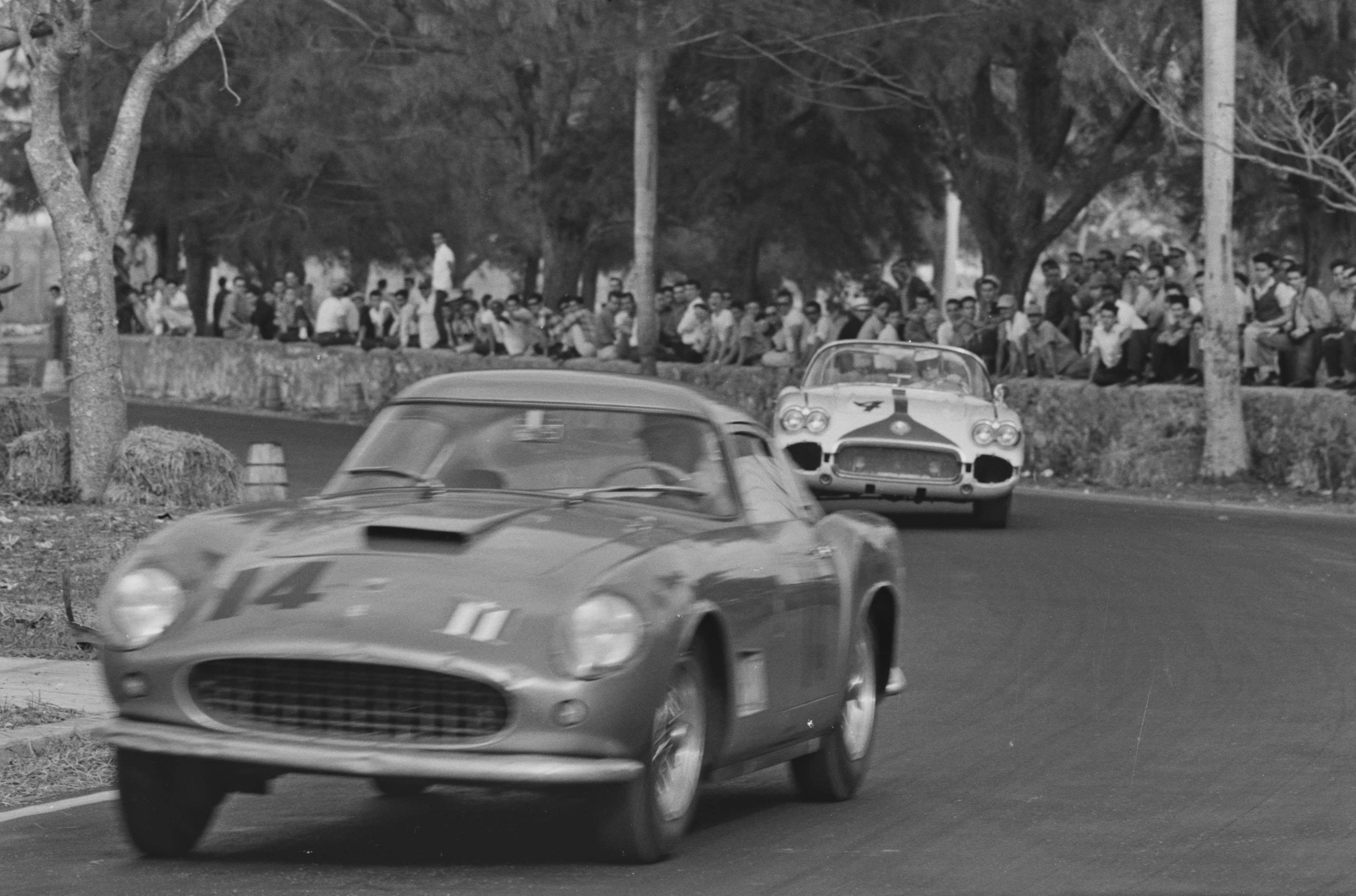
Action near Havana Country Club: Alfonso Gomez-Mena (sporting Cuban flag on the hood) in the #14 Ferrari 250 GT LWB, leads Jim Jeffords, USA, in the #4 Chevrolet Corvette C1. Photo: Tom Burnside, copyright The Revs Institute.
Back to the photographs. As I was only 11 years old at the time, so my father was at the track with me. He mentioned that he helped keep lap times for one of the teams during the race in 1958. I think it was for a team of privateers with a Mercedes sponsored by the Cuban cigarette makers, Trinidad y Hermanos (the MB factory teams had abandoned racing after Pierre LeVegh’s crash at Le Mans in 1955). As I stare at the photograph I recall the ripping sounds of small bore engines, straining at their redlines, the musical sequence of heel & toe downshifting and the pungent smells of racing oil, clutch and brake dust and racing fuels (which occupy a special place in my sense of smell, right next to cordite from antiaircraft shells and exploding bombs, but more on this later). I remember that the spectator stands lining the runway were provisional, made of wood, housing the makeshift pit area along the “front straight.” My house was so close to the runway that I could stand at the fence and watch the racers run the left sweeper in the “Curva Camaguey” followed by the tight right turn into the long straight. That was the most important sequence for the quickest lap. Crowd control was evidently not terribly tight, what with next-to-nonexistent racing car restraints like a hay bale every ten feet or so. But such was the innocence of that era: on track, my Dad let me roam about at will, evidencing all confidence that I would be alright.
Observing the photographs taken by Burnside, there are many signs and banners advertising products – Shell gasoline, Goodyear tires, LASO batteries, Hilton Hotels (the racing headquarters were at the Habana Hilton) Coca-Cola, and Polar and Hatuey beer. This may seem totally obvious to readers, but there’s more. Later that year Fidel Castro ordered the “intervention” of all businesses, beginning with the expropriation of major U.S. corporations. On August 6, 1960, the Castro government formally nationalized all foreign-owned property in the nation. By the end of 1960, the revolutionary government had stolen more than $25 billion worth of private property owned by Cubans – 1960 was the end of private enterprise.
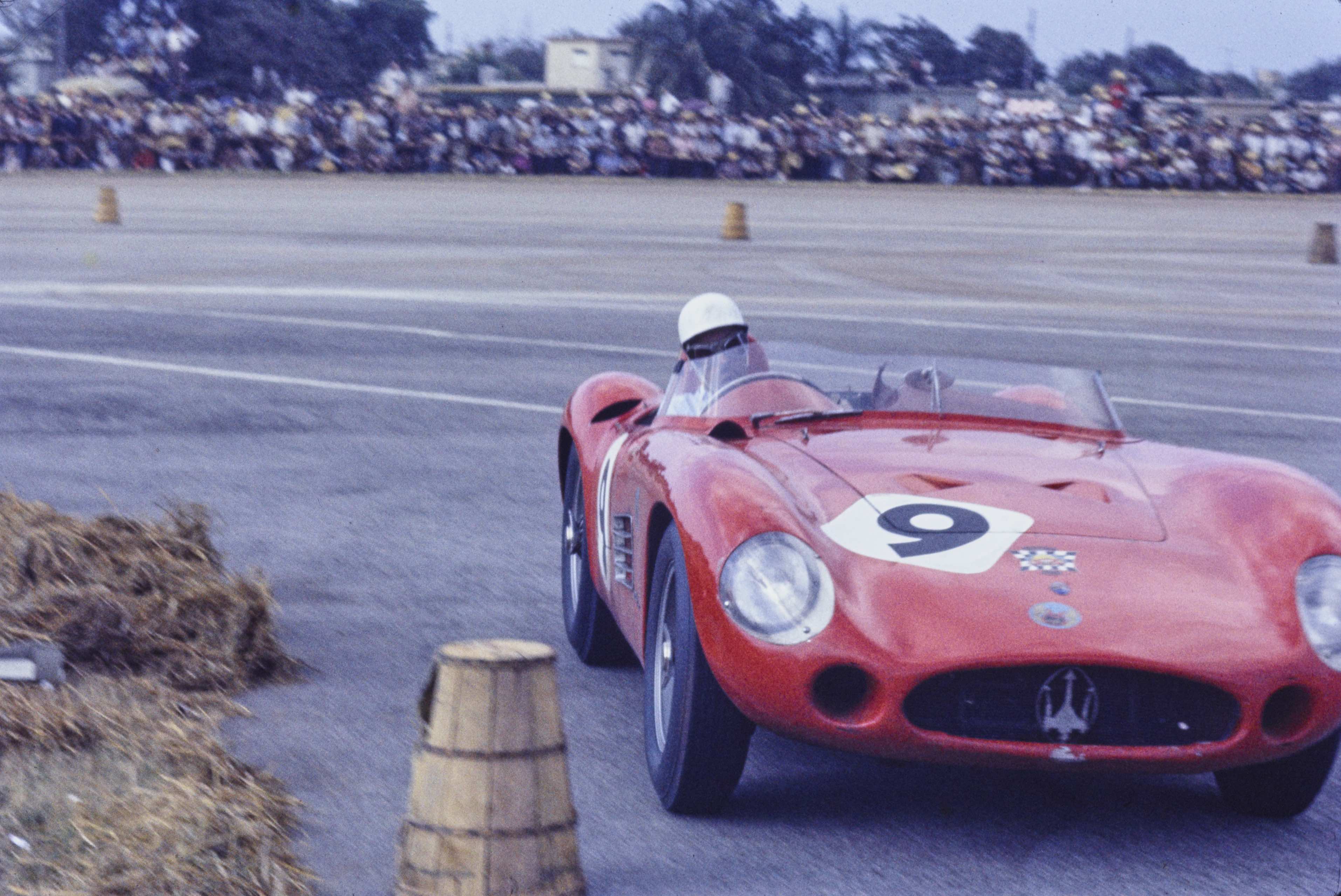
Maurice Trintignant, France, negotiates a right-hander onto the front straight in his #9 Maserati 300S. Photo: Tom Burnside, copyright The Revs Institute.
I wish I could give you more details on how the race went. Neither my father nor I had the foresight to hang on to a race program. But how was I to know, at age 11, of the magnitude of the event before me? Although my idol, Juan Manuel Fangio was not there, here were gathered the world’s best dueling at 180 mph in their golf shirts and penny loafers, darting about on skinny Dunlops sans driver restraints. Researching racing history, I found one version of the program (complete with someone’s handwriting) which listed 43 entries representing 14 nations. Among them were well known competitors including Joaquim Bonnier (Porsche RSK 1.5L), Jack Brabham (Cooper-Monaco 2.5L), Ettore Chimeri (Ferrari 3.0L), Masten Gregory (Porsche RSK 1.5L), Dan Gurney (Maserati 2.9L), Stirling Moss (Maserati Tipo 61 “Birdcage” 2.9L), Ulf Norinder (Porsche RSK 1.5L), brothers Pedro (Ferrari 3.0L) and Ricardo Rodriguez (Porsche RSK 1.5L), Eddie Sachs (Nisonger KLG Special 5.3L), Harry Schell (Ferrari 4.1L), Carroll Shelby (Porsche 1.5L), Maurice Trintignant (Maserati 3.0L), Huschke Von Hanstein (Porsche RSK 1.5) and Rodger Ward (Ferrari 2.9L). (Briggs Cunningham had been invited but refused to participate because Castro had already expropriated his businesses in Cuba). One Italian lady, Ada Pace, hurled her OSCA MT4 around the airport runway, her helmet more likely a leather head sock, with goggles and, in the tropical sunshine, sporting a sleeveless blouse – her careful manicure evident in her fingerless driving gloves. She finished her race!
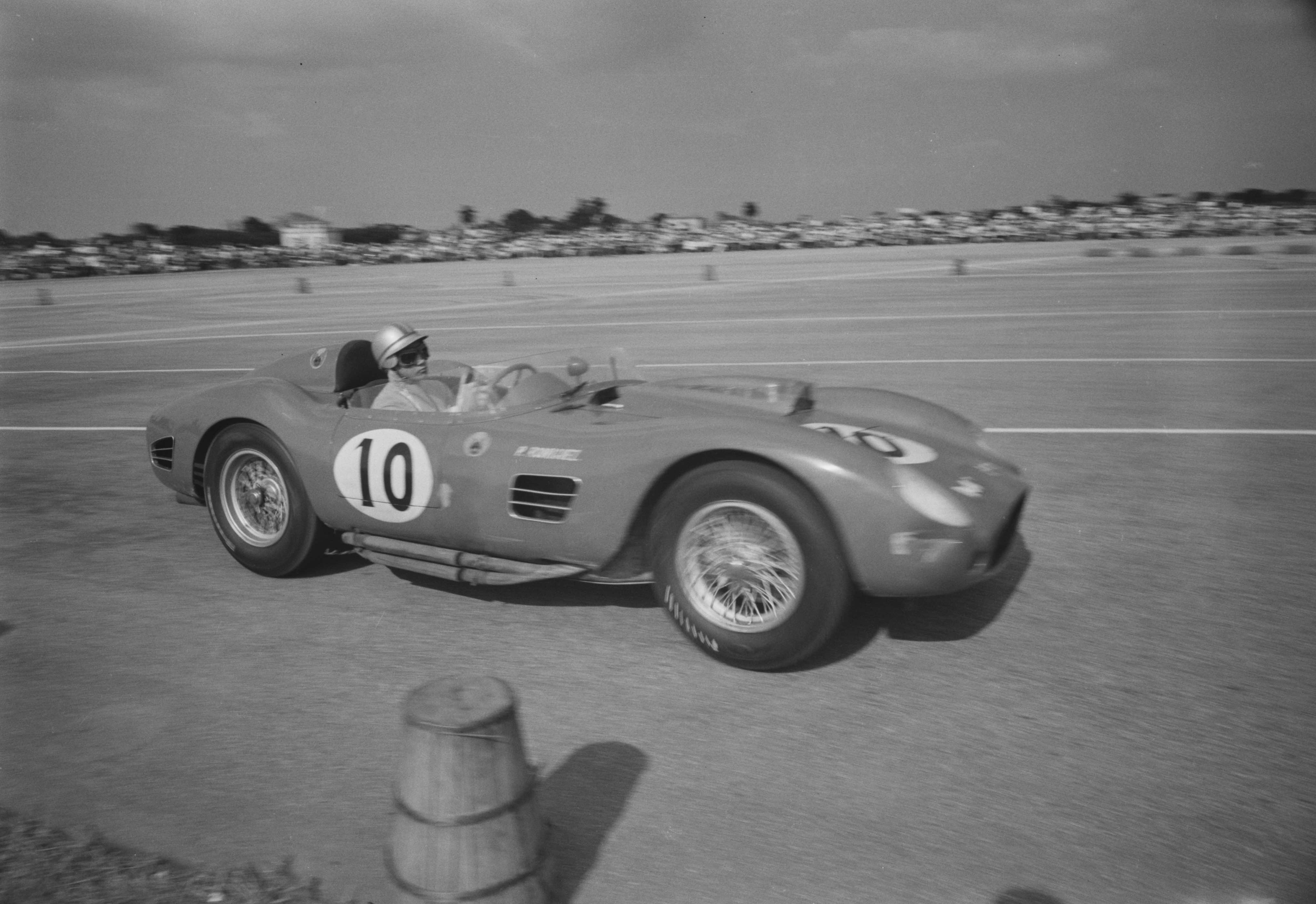
Pedro Rodriguez, Mexico, in the #10 Ferrari 250 TR 59, finished second overall and second in class in the 50 lap main race. Photo: Tom Burnside, copyright The Revs Institute.
As I look at the photograph, Tom Burnside suddenly becomes my hero, the only person who can bring back details of a memory that I’ve carefully nurtured all these years. I become infatuated with the photograph – I must locate him. Finding a phone number for him, I ever so cautiously ring him up. He answers. I can’t believe he answers his own phone! I introduce myself, and I tell him about the photograph and that I was there. I’m thinking he’ll say, “Yeah, so what, I know many people who were there, big deal.” But instead, he says, “You’re the first person who has contacted me who says he was there!” Burnside remembers that Stirling Moss drove a birdcage Maserati (a white number 7, I remember distinctly). He also knows that a Jaguar XKSS was entered (and that it was just repatriated from Cuba to the US for some astronomical sum). He also tells me about the time in ’57 when he was in Havana for the Gran Premio, staying at the El Presidente hotel where he received a visit at 3:00 am from Castro’s representatives, who take him back to their lair (but that’s Burnside’s story to tell). At the airport, he said the race was run clockwise using the runway with mostly curves to the right using some of the service roads. There is one more personal detail that I recall: as the featured race ended and the crowds were leaving, I gathered a few of my friends and stuffed wads of paper in the tailpipes of spectator cars parked all around our neighborhood. Then we watched with glee as the wads rocketed out of the tailpipes when the engines were started.
One year later, on Saturday, April 15, 1961, at 6:00 am, the thunder of low flying airplanes shook the house. But accustomed as we were to airplanes overhead, this was different: there was more than one, and their approach to the airport was not supposed to be over our house, and they are coming in TOO LOW! Then all hell breaks loose as these airplanes begin strafing the military airport and Castro’s Czechoslovakian 4-barrelled antiaircraft batteries reply in kind. The ground leaps as bombs hit their targets. I grab my baby sister out of her bed and our family runs screaming into the dining room, sliding under the dining room table, everyone praying loudly for God to spare us and literally feeling every bomb hit through the cold hard, tile floor. I have never before or since been so afraid for my life. We expect a bomb to hit our house any second as the bombers (CIA-supplied Douglas A-23’s of the anti-Castro assault force of Alpha 66) make their runs at their targets. Twenty minutes later the bombers leave, but they have decimated the airport. The ordinance, which had been trucked into the air base only a week earlier, is now exploding at will. We run to the car, in our sleepwear, not stopping for anything. We drive away to my mother’s cousin in the western suburbs of Miramar. Two days later, 1,500 men make shore in a crocodile-infested swamp known to the rest of the world as the Bay of Pigs.