
Mark your calendars! The tenth annual Michael R. Argetsinger Symposium is scheduled for Thursday and Friday, November 12 and 13, 2026 at the Harbor Hotel in Watkins Glen, NY. The Symposium is held annually by the International Motor Racing Research Center (IMRRC) in partnership with the Society of Automotive Historians (SAH).
Racing enthusiasts of all descriptions will find intriguing presentations and the opportunity to engage in dialogue with thoughtful experts and fellow enthusiasts of the sport. Don’t miss this unique opportunity to enjoy the glories of motor sports history with like-minded racing addicts!
About the Michael R. Argetsinger Symposium on International Motor Racing History
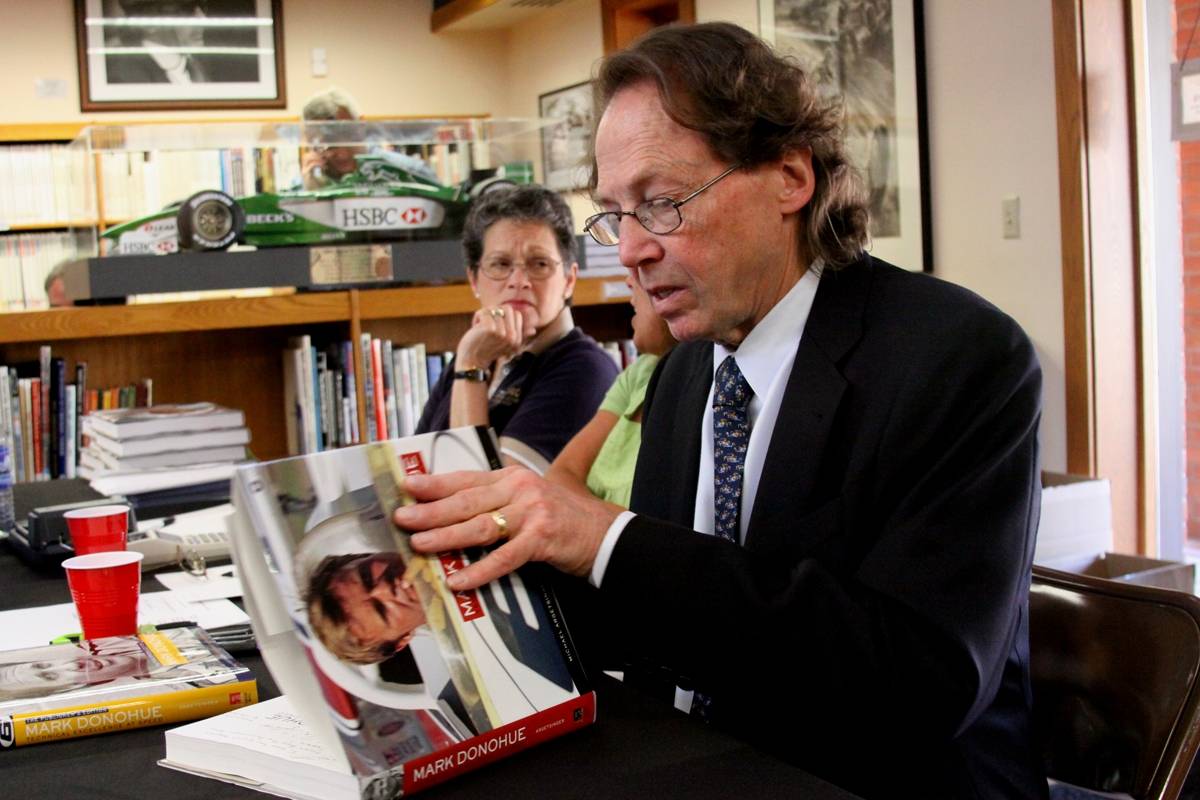
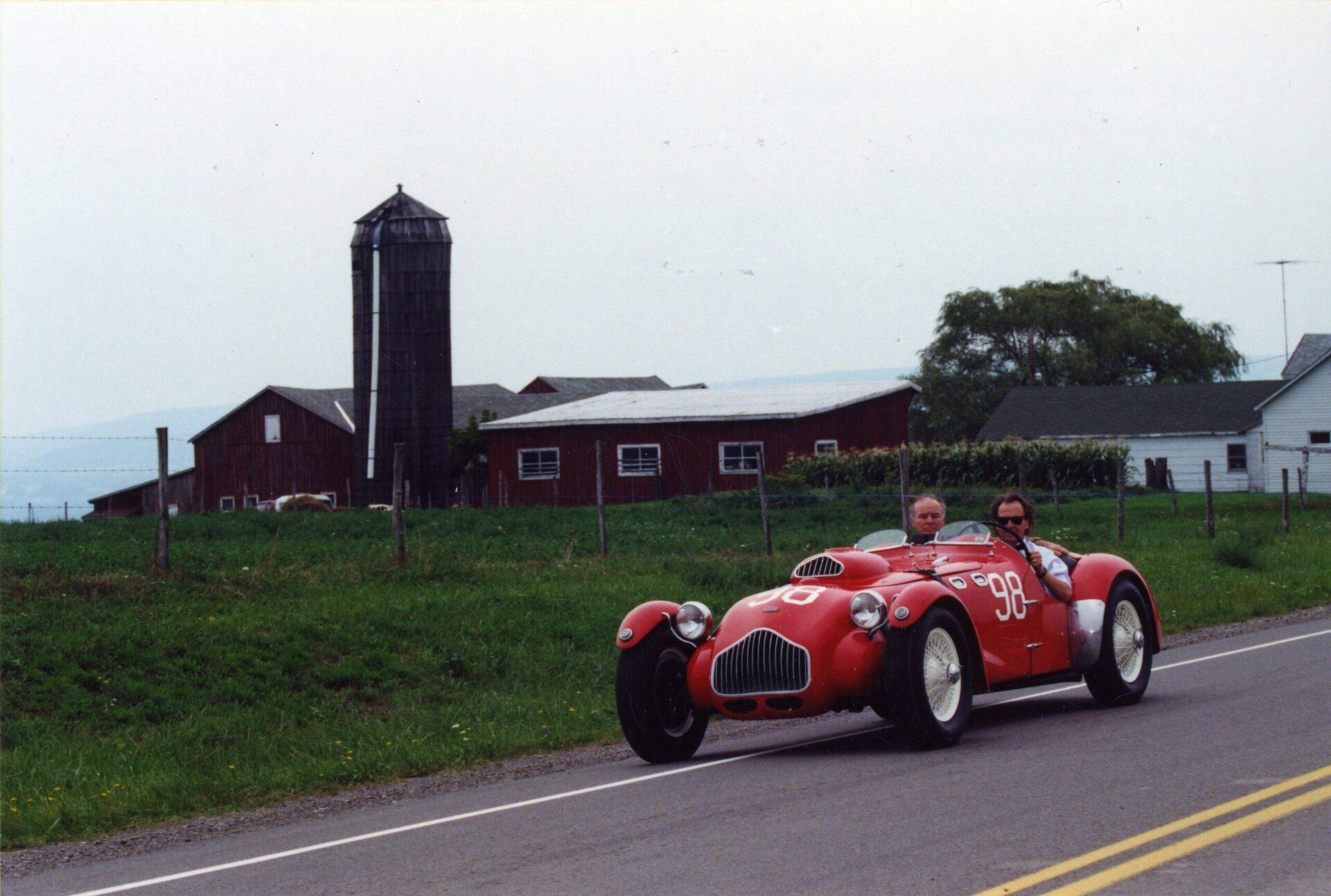
The International Motor Racing Research Center (IMRRC) partners with the Society of Automotive Historians (SAH) to present the Michael R. Argetsinger Symposium on International Motor Racing History each fall in Watkins Glen, NY. The Symposium is named in honor of Michael R. Argetsinger (1944-2015; below), an award-winning motorsports author and longtime member of the IMRRC Governing Council.
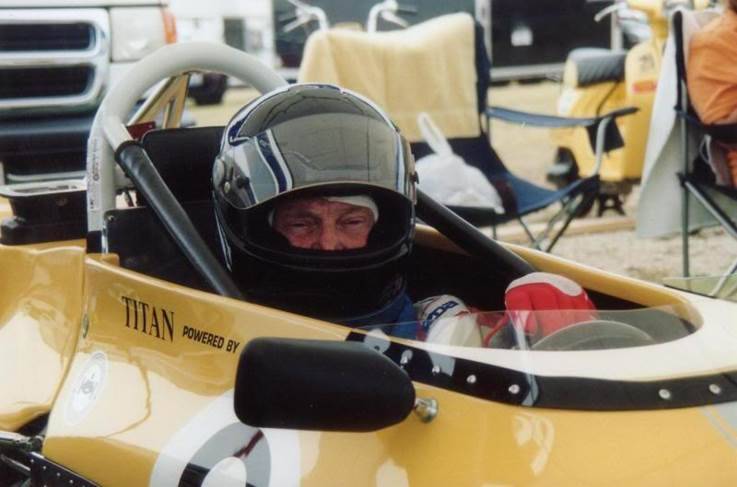
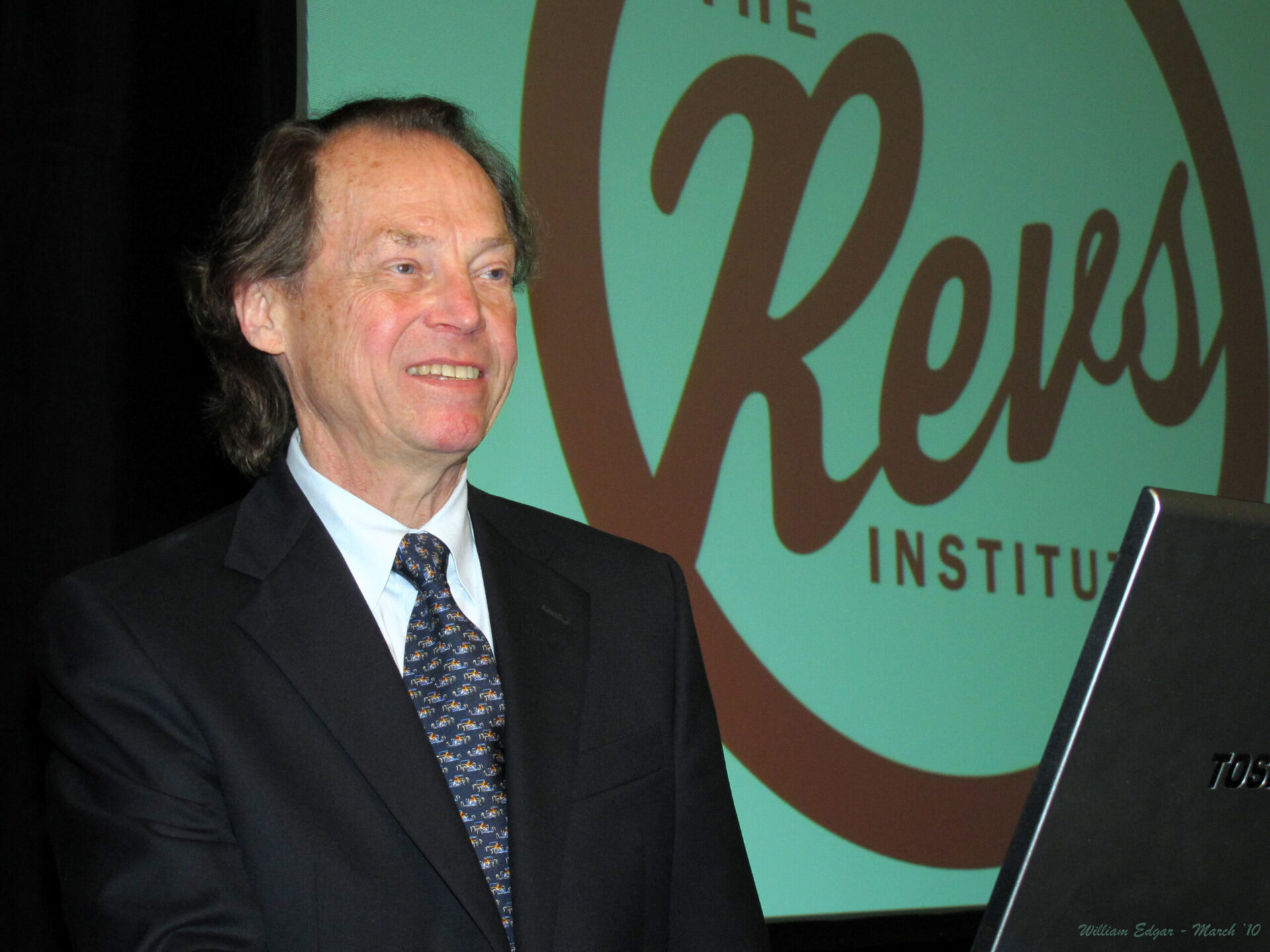
The Symposium provides an amicable venue for authors, academic motorsport scholars, enthusiast historians, and students to share their knowledge of various aspects of motorsport history with the enthusiast and academic communities, both in-person and virtually.
9th Annual - 2025 Presentations
The Renaissance of Watkins Glen in the 1980s
J.J. O’Malley has been covering motorsports in many capacities since 1973. After graduating from King's College in Wilkes-Barre, Pennsylvania, he was News Editor for Chris Economaki's National Speed Sport News in 1977. He then began a six-year stint as assistant sports editor for the Pocono Record in Stroudsburg, Pa. Since 1984, it’s been exclusively motorsports for O’Malley. He was media director for Watkins Glen International when the circuit reopened, and then joined Homestead-Miami Speedway as public relations director in 1998. O’Malley moved to ISC headquarters in 2001 as news editor for ISC Publications, and was involved with Grand-Am Road Racing since its debut in 2000. He joined the sanctioning body full time in 2008 as manager of communications, and remained through the merger of Grand-Am and the American Le Mans Series as manager of communications for IMSA until 2016.
Currently a Sunday Group Management content contributor, O’Malley has written 13 books on racing, including Daytona 24 Hours: the Definitive History of America’s Great Endurance Race, Volumes 1 and 2. O’Malley is an honorary member of the prestigious Road Racing Drivers Club.Show More
J.J. O’Malley has been covering motorsports in many capacities since 1973. After graduating from King's College in Wilkes-Barre, Pennsylvania, he was News Editor for Chris Economaki's National Speed Sport News in 1977. He then began a six-year stint as assistant sports editor for the Pocono Record in Stroudsburg, Pa. Since 1984, it’s been exclusively motorsports for O’Malley. He was media director for Watkins Glen International when the circuit reopened, and then joined Homestead-Miami Speedway as public relations director in 1998. O’Malley moved to ISC headquarters in 2001 as news editor for ISC Publications, and was involved with Grand-Am Road Racing since its debut in 2000. He joined the sanctioning body full time in 2008 as manager of communications, and remained through the merger of Grand-Am and the American Le Mans Series as manager of communications for IMSA until 2016.
Currently a Sunday Group Management content contributor, O’Malley has written 13 books on racing, including Daytona 24 Hours: the Definitive History of America’s Great Endurance Race, Volumes 1 and 2. O’Malley is an honorary member of the prestigious Road Racing Drivers Club.Show More
Joe Schill began his professional career as a high school social studies teacher before going back to school to get a library science degree. His first job as an archivist was at the Rakow Research Library at Corning Museum of Glass (2019-2024). He is passionate about history in general and is always happy to discuss the fascinating history of Upstate New York. Joe has been head archivist at the IMRShow More
energy into motorsports and have proven instrumental in attracting a younger, more diverse audience.
While traditional media persists as a core aspect of fan experience both at the track and beyond it, the continuing developments of the digital age have redefined the fan experience. This presentation examines how technological milestones, public policy, commercial developments, digital growth, and changing societal norms have reshaped fan engagement across the sport’s history and how they might influence the sport going forward.
Lucas Laager is a Motorsport Management major at Belmont Abbey College. Before attending BAC, Lucas graduated from Roger Williams University where he majored in History. While at RWU he authored his thesis on the development of safety in motor racing with a focus on Formula One and Le Mans, and participated in original research about free and enslaved people of color in the local area, which has been published in the Rhode Island Genealogical Society Journal Rhode Island Roots. Lucas is also a member of the Phi Alpha Theta National History Honor Society.Show More
Skip McGoun is the William H. Dunkak Emeritus Professor of Finance at Bucknell University and was a long-term Visiting Professor at the University of Ljubljana in Slovenia and at the University of Donja Gorija in Montenegro. He has presented and published on the history and culture of finance as well as automobile history and culture and served as Area Chair of the Vehicle Culture Section of the Popular Culture Association.Show More
Andrew Beckman has been with the Studebaker National Museum since 1999 and currently serves as Archivist. He previously worked at the Sheboygan County Historical Society in Sheboygan, Wisconsin, and the Wade House State Historic Site in Greenbush, Wisconsin. Mr. Beckman hails from Manitowoc, Wisconsin, and holds a BA in History from the University of Wisconsin- Green Bay. In 2004, he completed the Modern Archives Institute at the National Archives and Records Administration in Washington, D.C. In 2009, he earned his mid-level certificate in Collections Preservation from the Campbell Center for Historic Preservation Studies in Mount Carroll, Illinois. Mr. Beckman is the author of The Studebaker National Museum: Over a Century on Wheels, and Studebaker’s Last Dance: The Avanti, and is a columnist for the Studebaker Drivers Club magazine, Turning Wheels.
In addition to his duties at the Studebaker Museum, Mr. Beckman is a member and Past President of the Society of Automotive Historians. He also serves as a commentator for The Henry Ford Museum’s Motor Muster and Old Car Fest.Show More
Paul Baxa is Professor of History at Ave Maria University in Florida. Parts of his most recent book, Motorsport and Fascism: Living Dangerously have been presented at past Argetsinger Symposia. He was privileged to have presented at the first symposium in 2015.Show More
Mark’s keynote address, laced with engaging anecdotal tales and an accurate, factual description of the series, covers his own colorful career in motorsports and the emergence and remarkable success story of IMSA racing over the course of more than forty years.
Mark Raffauf, currently IMSA's Senior Director of Competition, has held IMSA positions through many iterations of IMSA and Grand-Am, including being the second president, in overall management, technical and car regulation development, as well as event, circuit, starting, and racing operations. He is the author, with Mitch Bishop, of IMSA 1969-1989: The Inside Story of How John Bishop Built the World's Greatest Sports Car Racing Series and IMSA 1990-1999: The Turbulent Years of American Sports Car Racing.Show More
This update highlights significant developments, including the launch of the nation’s first Master of Arts in Motorsport Management and the Accelerate Abbey summer program, which introduces high school students to the sport's diverse historical and professional landscape. We also discuss the expansion of archival resources through a generous donation from historian Donald Capps, a direct outcome of prior Argetsinger Symposium connections.
Attendees will gain insight into how Belmont Abbey’s curriculum uses motorsport history—across continents and categories—as a lens for critical thinking, cultural understanding, and professional development. The session will explore our lessons learned, evolving strategies, and vision for preparing the next generation of motorsport professionals.
Quinn Beekwilder is an assistant professor and coordinator of the Motorsports management degree at Belmont Abbey College. Having worked for a decade at Charlotte Motor Speedway, he wanted to give back to the Motorsport program at Belmont Abbey that got him there in the first place. He has a unique perspective of being one of the first graduates of the program and is able to address concerns and direct the program for the greater benefit of current students. Motorsports history has always been a passion of Mr. Beekwilder. The approaches he takes to the courses are crafted to focus on the historical development of NASCAR while incorporating experimental activities to support the curriculum. The students refer to Mr. Beekwilder as "the fast van driver."Show More
Normalcy, however, did not play out in 1975. Both on and off the track, lasting changes in how American motorsports was sanctioned, where events would take place, and how it reached the masses was markedly different in 1979 than when the first green flag waved in January 1975.
The NASCAR Winston West Series was no exception. In 1975, the winningest champion in Series history tacked on a sixth and final title before suddenly semi-retiring to the family farm. Meanwhile, an age-defying lumberman who began racing in 1945 was still getting warmed up.
A 41-year-old journeyman Californian picked up his first championship in 1977—only to win again in 1979. One of the most prolific Canadian stock car drivers of all-time won his first race, and a one-time Series champion made a monumental impact at California’s iconic Riverside International Raceway—in a fraction of a race.
Normalcy? What a time it was!
Daniel J. Simone earned his Ph.D. in American History from the University of Florida in 2009. From 2010-2015, Dr. Simone taught World History and Environmental History at Monmouth University. Curator of the NASCAR Hall of Fame in Charlotte, North Carolina, and held that position through 2021. The following year, he was tabbed to assist the New York Historical Society Museum & Library, where he co-processed the Women's Sports Foundation Collection and developed content for digital exhibition. Dr. Simone is on the editorial board of the Journal of Motorsport Culture & History and serves on the Indianapolis Motor Speedway Hall of Fame Voting Committee.Show More
Drawing on archival records, oral histories, and community recollections, the presentation will trace the fairgrounds’ early role in regional motorsports and its subsequent decline. The narrative then shifts to the 1980s, when members of EMMR revived the dormant track, reimagining it as one of the nation’s first dedicated vintage race car exhibition tracks. This groundbreaking effort not only safeguarded the physical site but also transformed Latimore Valley into a dynamic venue where history is experienced through live demonstrations.
This presentation examines the importance of institutional memory—how a museum’s collective knowledge, rooted in personal experience and preserved documentation, guides decisions about preservation, programming, and community engagement. It explores how EMMR has leveraged institutional memory to connect multiple generations of motorsports enthusiasts and create continuity between past and present.
Alison Kreitzer is Director of Collections at the Eastern Museum of Motor Racing in York Springs, Pennsylvania. She earned her Ph.D.
in the History of American Civilization from the University of Delaware in 2017.Show More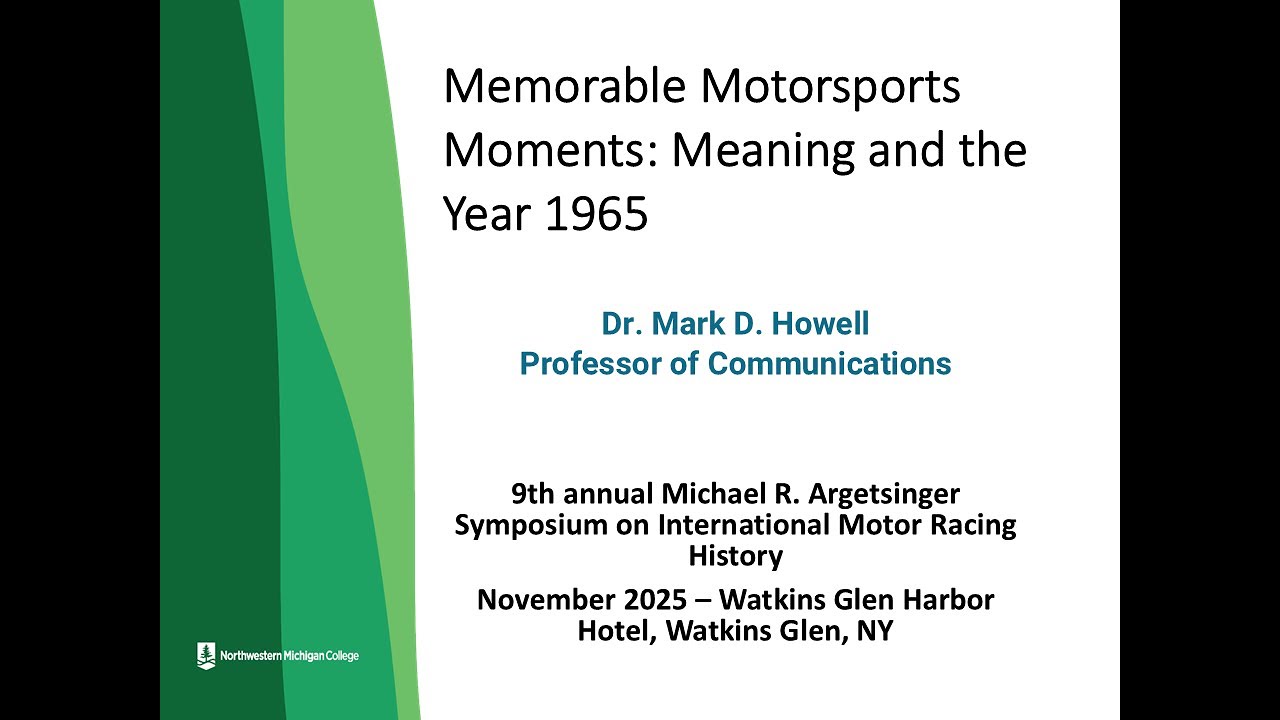
The ...discussion highlights groundbreaking motor racing events as well as significant space explorations of 1965. It also acknowledges the innovators who reshaped international motorsports sixty years ago - individuals and achievements that stand as defining forces in a pivotal year for motor racing history.
Dr. Howell proposes that the past six decades of motorsports and crewed
space exploration were directly shaped by the innovations, inventions, and intentions of 1965. It was a year that showcased the exceptional talents of Fred Lorenzen, Frank Borman, Jim Clark, Ed White, Dan Gurney, Jim Lovell, and others, all while establishing a benchmark for the technological and competitive advances that followed. What was accomplished during 1965 continues to influence the areas of both motor racing and space exploration to this day.
Dr. Mark D. Howell has been involved with motorsports his entire life (thus far). He earned a BA in English in 1987 and an MA in American Studies in 1990 from Penn State, then earned a Ph.D. in American Culture Studies from Bowling Green State University in 1995. His dissertation evolved into From Moonshine to Madison Avenue: A Cultural History of the NASCAR Winston Cup Series, published in 1997. In 2014, Howell co-edited (with Dr. John Miller of Longwood University) Motorsports and American Culture: From Demolition Derbies to NASCAR.
Howell’s full-time job since August of 1997 has been as a Professor of Communications at Northwestern Michigan College in Traverse City. He spent two years before NMC as a Visiting Assistant Professor in the Department of American Thought and Language at Michigan State University. Mark has also taught advanced courses for Tiffin University, Oakland University, Ferris
State University, and Davenport University. Dr. Howell is on the Board of Directors of the Society of Automotive Historians, and is editor of the SAH’s Automotive History Review.Show More
Arthur Carlson is the Director of Archives and Research Center Operations at Revs Institute, in Naples, Florida. He is committed to utilizing emerging technologies to enhance access and discovery of archival resources. He recently presented on digital archival repositories at the 2024 International Dickens Symposium in Birmingham, UK.Show More 8th Annual - 2024 Presentations
From Powder Puff to W Series: The Evolution of Women-Only Racing
to women. Consequently, it has been necessary for female racers to develop unique strategies to enter what has long existed as an exclusive ...masculine enclave. While entry can be facilitated through a familial relationship with a male driver, women without such connections often get their start through participation in women-only racing events. Although these races have provided women with the opportunity to enter the track, they have not been without controversy. Detractors argue that women will not be considered legitimate racers unless they compete on the same track as men. Proponents view women-only racing not only as a way to attract more women into the sport, but also as an important source of skill development, support, and community building.
This paper investigates the evolution of women-only racing, from its early introduction as a media stunt, to its current incarnation as a proving ground for serious female open-wheel racers. Informed by archival resources and motorsport scholarship, it considers how women-only racing complicates, facilitates, and liberates women’s entry, participation, and recognition in the masculine world of motorsports.
This livestream was presented via twitch.tv/grantouringmotorsports and produced by The Motoring Podcast Network - learn more at https://www.motoringpodcast.netShow More
to women. Consequently, it has been necessary for female racers to develop unique strategies to enter what has long existed as an exclusive ...masculine enclave. While entry can be facilitated through a familial relationship with a male driver, women without such connections often get their start through participation in women-only racing events. Although these races have provided women with the opportunity to enter the track, they have not been without controversy. Detractors argue that women will not be considered legitimate racers unless they compete on the same track as men. Proponents view women-only racing not only as a way to attract more women into the sport, but also as an important source of skill development, support, and community building.
This paper investigates the evolution of women-only racing, from its early introduction as a media stunt, to its current incarnation as a proving ground for serious female open-wheel racers. Informed by archival resources and motorsport scholarship, it considers how women-only racing complicates, facilitates, and liberates women’s entry, participation, and recognition in the masculine world of motorsports.
This livestream was presented via twitch.tv/grantouringmotorsports and produced by The Motoring Podcast Network - learn more at https://www.motoringpodcast.netShow More
Yasenko is a lifelong car enthusiast, business owner, restorer and historian, automotive show host, and all-around jack of all trades.Show More
In this story, the imaginary Italian “Unione Automobili”, previously formed of national legacy manufacturers other than Fiat, takes on the role of the Auto Union AG of the 1930s as an antagonist of Mercedes-Benz and promoter of the mid-engine layout. A probabilistic SWAT analysis reveals what it will take to beat the mighty opponent from Stuttgart. This is the start for a motley crew of Austrian and Italian engineers lead by Robert Eberan-Eberhorst to create a victorious challenger. The prescribed
engine configuration is a compact V6 in homage to the Lancia brand. Breaking with Italian traditions, emphasis is put on chassis development where innovations in tires, brakes, and aerodynamics will provide decisive competitive advantages.
This livestream was presented via twitch.tv/grantouringmotorsports and produced by The Motoring Podcast Network - learn more at https://www.motoringpodcast.netShow More
The focus of this presentation is to provide a brief overview of E-motorsports with a look at Formula-E (conceived in 2012 and sanctioned by the FIA during the 2020-21 season) and Extreme-E (conceived as a project in 2018 led by Formula E founder Alejandro Agag and former driver Gil de Ferran; it was launched in January 2019).
Highlights of recent developments and related projects will also be included, particularly those with electrification and clean energy connections
This livestream was presented via twitch.tv/grantouringmotorsports and produced by The Motoring Podcast Network - learn more at https://www.motoringpodcast.netShow More
participating almost every weekend from January to October. The collection comprises extensive race results, news clippings, programs, and even race banquet menus, offering a remarkable glimpse into the life of an everyman driver.
Roberts’ presentation discusses how the International Motor Racing Research Center (IMRRC) supports both researchers and race enthusiasts while preserving the legacies of drivers like Crowther. Visual accompaniments will include Crowther's race helmet, photographs of him in action, and his rallying clipboard. Through these artifacts, Roberts will highlight the IMRRC's role in keeping motorsports history alive and accessible.
This presentation will not only celebrate Crowther's extensive racing career but also emphasize the importance of archival research centers in maintaining motorsport and driver heritage.
This livestream was presented via twitch.tv/grantouringmotorsports and produced by The Motoring Podcast Network - learn more at https://www.motoringpodcast.netShow More
based entries, and the President’s rugged eight powered a pair of private entries. These Studebaker-engined specials showed promise and led to the development of Studebaker’s corporate team.
This program will detail the origins and evolution of Studebaker-powered racers beginning in 1930 with a special emphasis on the company’s factory-backed campaigns in 1932 and 1933. Additional focus will also be placed on the technical development of the Studebaker racers as well as the post-Studebaker disposition of the team cars and their present-day status.
Sources include Studebaker’s corporate archives and image collection at the Studebaker National Museum plus period publications and race accounts. Additional data is drawn from secondary sources profiling the Studebaker team plus owner research compiled during their stewardship of the cars.Show More
John Bond (1912-1989) and his wife Elaine bought the faltering magazine Road & Track ...in 1949. Over the course of his ownership and editorship, Bond built the magazine into a major cultural force. This presentation examines the dimensions that Bond engaged with his editorial viewpoint from a wholistic cultural lens. Bond built a durable version of car culture, the practices and values of which remain in many forms today, though under challenge from old and new trends in the automotive industry.
Bond’s version of car enthusiasm stemmed directly from two sources: his education at the General Motors Institute and his enthusiasm for European racing. Road & Track’s coverage of the foreign motorsports scene for some time was the only widely available source material for an American audience.
This presentation argues that Bond’s two decade editorship (1951-1972) of Road & Track created the foundational dimensions of traditional “car guy” culture, with its familiar and clubby atmosphere familiar to those “in the know,” but also acted in an exclusionary way to women, casual automobile and racing enthusiasts, and those who might have appreciated automobiles from other dimensions than their mechanical design or performance on certain tests.
Finally, the presentation examines Bond’s version of car culture in a contemporary light, considering the roles of the changing nature of racing and its relationship to road vehicles, the renaissance in electric vehicles, and debates about mobility in the contemporary climate.
***An Anthropological Perspective: John Bond, Road & Track, and the Formalization and Transmission of Car Culture. Ken Yohn
This presentation will explore car culture from an anthropological perspective, as a complex whole combining both behavior and the material objects integral to the behavior. This formulation of culture thus includes material artifacts, rituals, customs, language, beliefs, institutions, and techniques, among other elements. This presentation will address two main questions. As presented in Road & Track, what are the essential elements (behavior and artifacts) of car culture? Second, can we learn anything, or draw non-obvious conclusions about car culture by adopting this type of anthropological perspective?
***Woman’s Place (in Car Culture): John Bond, Road & Track, and the Evolution of Gender Representation. Kristie Sjoka
This presentation will explore the progression of gender representation within the time that John Bond owned and edited Road & Track magazine. It will examine all aspects of the publication between the years of 1951-1972, including cover art, article content, photographs, and advertising. The presentation will compare and contrast the first ten years of Bond’s editorship with the last ten years to identify any potential changes in female representation. With the historical perspective of developing gender politics of the time period, the presentation will consider whether these societal shifts had any impact on women’s representation within the pages of the publication.
This livestream was presented via twitch.tv/grantouringmotorsports and produced by The Motoring Podcast Network - learn more at https://www.motoringpodcast.netShow More
Part of this paper looks at NASCAR’s connection to various political candidates, both during campaigns and after votes have been counted (and certified). Another section of this presentation examines the use of race cars as campaign promotional “vehicles” over the years.
This paper explores the very public and very strategic alliance between political candidates and NASCAR Nation. From Jimmy Carter welcoming Grand National drivers to The White House to Ronald Reagan sharing Kentucky Fried Chicken with Richard Petty, the relationship between stock car racing and politics presents itself as a calculated combination of regional identity and popular culture-driven stereotypes.
This livestream was presented via twitch.tv/grantouringmotorsports and produced by The Motoring Podcast Network - learn more at https://www.motoringpodcast.netShow More
The purpose of the current literature review is to summarize the current academic literature across two repositories (EBSCO Host & Google Scholar) to gain a broader understanding of this academic realm of inquiry. Various search term including Women in Racing and variants were included in the search. Initial results suggest that women in motorsport are often a part of academic research, but are less so the main focus. Using the PRISMA methodology, articles were selected from relevant criteria and reduced from a larger sample. Methods and themes from articles will be discussed.
This livestream was presented via twitch.tv/grantouringmotorsports and produced by The Motoring Podcast Network - learn more at https://www.motoringpodcast.netShow More
This livestream was presented via twitch.tv/grantouringmotorsports and produced by The Motoring Podcast Network - learn more at https://www.motoringpodcast.netShow More 7th Annual - 2023 Presentations
Ricordando Giacomelli e l'Alfa Romeo che hanno quasi vinto l'ultimo GP degli SU a Watkins Glen
October 5, 1980, was a very important day at Watkins Glen International circuit. Historical ...research, including about motor racing, cannot be done with hypotheses or with “what ifs” but only with facts. However, it can indeed be conceived that the facts of that day affected many future things. This was going to be the last F1 GP at Watkins Glen. The starting grid had an unexpected pole sitter: the Alfa Romeo of Giacomelli. Those were the years of Ferrari, winner of 1979 championship, of Lotus, winning in 1978, while the age of Williams was just beginning. Alfa Romeo, although possessing ancient racing victories, was back in racing for less than 2 years. Giacomelli, an Italian driving a fully Italian car, started on the pole maintaining firmly his lead position. He kept the lead and seemed close to an extraordinary win. Suddenly, a minor electrical problem stopped him on the track and the Williams of Jones won the race. One wonders what would have been if Giacmelli had won. Perhaps Alfa Romeo’s racing efforts would not have been discontinued as happened and a second major Italian team would have stayed in Formula 1. Possibly a prestigious F1 win in the US, the major car market in the world, and eventual further successes could have improved the prospects of Alfa Romeo to remain an Italian state property and continue to progress as an independent firm.
The International Motor Racing Research Center (IMRRC), partnering with the Society of Automotive Historians (SAH), presents the Seventh Annual Michael R. Argetsinger Symposium on International Motor Racing History. The Symposium established itself as a unique and respected scholarly forum and has gained a growing audience of students and enthusiasts. It provides an opportunity for scholars, researchers and writers to present their work related to the history of automotive competition and the cultural impact of motor racing. Papers are presented by faculty members, graduate students and independent researchers.
The history of international automotive competition falls within several realms, all of which are welcomed as topics for presentations, including, but not limited to: sports history, cultural studies, public history, political history, the history of technology, sports geography and gender studies, as well as archival studies.Show More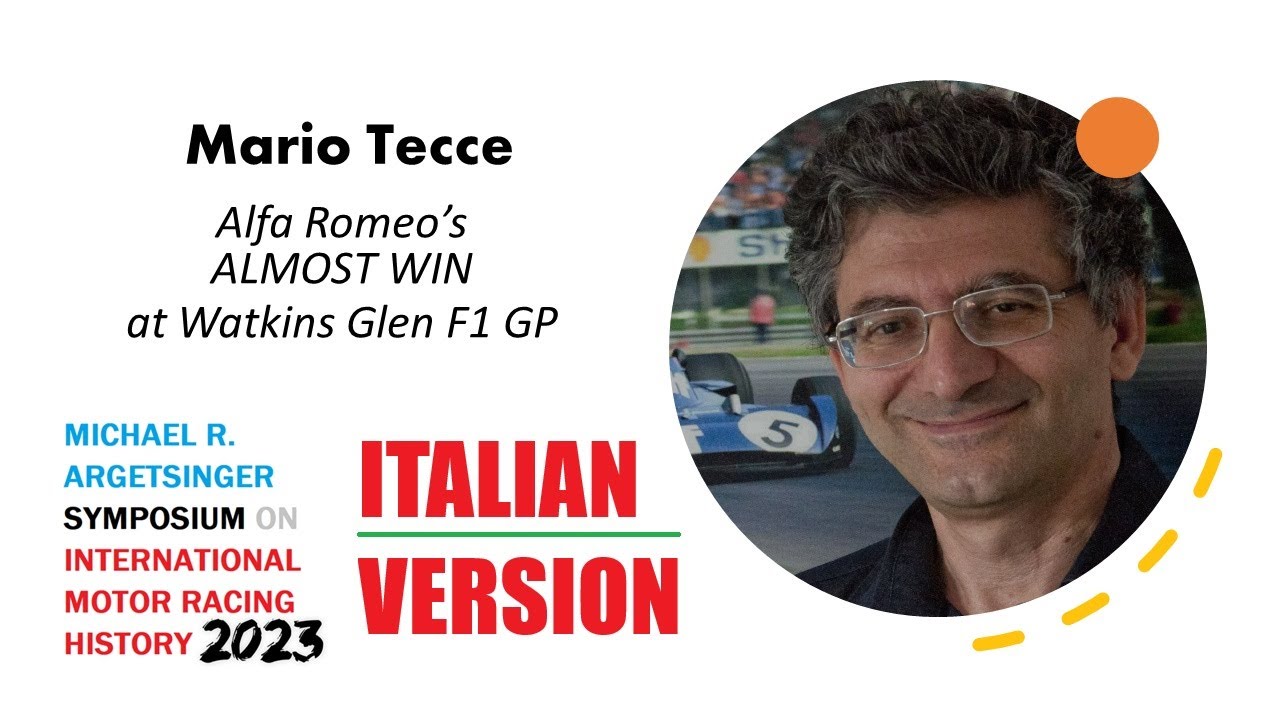
October 5, 1980, was a very important day at Watkins Glen International circuit. Historical ...research, including about motor racing, cannot be done with hypotheses or with “what ifs” but only with facts. However, it can indeed be conceived that the facts of that day affected many future things. This was going to be the last F1 GP at Watkins Glen. The starting grid had an unexpected pole sitter: the Alfa Romeo of Giacomelli. Those were the years of Ferrari, winner of 1979 championship, of Lotus, winning in 1978, while the age of Williams was just beginning. Alfa Romeo, although possessing ancient racing victories, was back in racing for less than 2 years. Giacomelli, an Italian driving a fully Italian car, started on the pole maintaining firmly his lead position. He kept the lead and seemed close to an extraordinary win. Suddenly, a minor electrical problem stopped him on the track and the Williams of Jones won the race. One wonders what would have been if Giacmelli had won. Perhaps Alfa Romeo’s racing efforts would not have been discontinued as happened and a second major Italian team would have stayed in Formula 1. Possibly a prestigious F1 win in the US, the major car market in the world, and eventual further successes could have improved the prospects of Alfa Romeo to remain an Italian state property and continue to progress as an independent firm.
The International Motor Racing Research Center (IMRRC), partnering with the Society of Automotive Historians (SAH), presents the Seventh Annual Michael R. Argetsinger Symposium on International Motor Racing History. The Symposium established itself as a unique and respected scholarly forum and has gained a growing audience of students and enthusiasts. It provides an opportunity for scholars, researchers and writers to present their work related to the history of automotive competition and the cultural impact of motor racing. Papers are presented by faculty members, graduate students and independent researchers.
The history of international automotive competition falls within several realms, all of which are welcomed as topics for presentations, including, but not limited to: sports history, cultural studies, public history, political history, the history of technology, sports geography and gender studies, as well as archival studies.Show More
The history of international automotive competition falls within several realms, all of which are welcomed as topics for presentations, including, but not limited to: sports history, cultural studies, public history, political history, the history of technology, sports geography and gender studies, as well as archival studies.Show More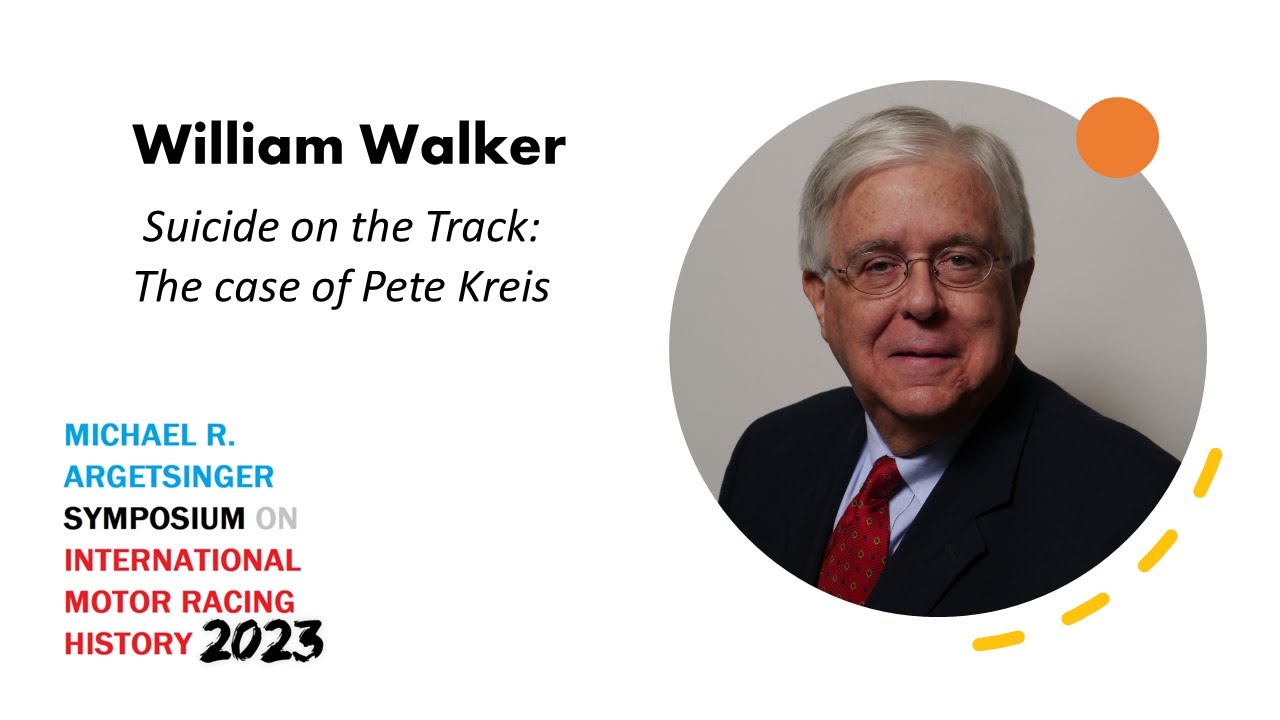
Since retiring, Walker has returned to an enduring love — researching and writing narrative history books. His first book was Betrayal at Little Gibraltar, a study of a World War I battle published by Scribner in 2016, followed by The Last Lap, the story of the fast lap and strange death of Pete Kreis. He lives in Staunton, VA.
The possibility of drivers dying by suicide on the track has long been acknowledged, sometimes alleged, but seldom proven. It remains a forbidden topic, because drivers are unwilling to admit any weakness, much less depression. The case of Pete Kreis, however, offers an opportunity to examine a case which resulted in two purposeful deaths at the Indianapolis Motor Speedway. Pete raced at Indy from 1925 to 1934, when he and his riding mechanic died in Turn One. A “coroners’ jury” of Indy drivers, track officials, and other experts could not identify any obvious cause for the accident, calling it “the strangest death in all racing history.” After 50 years of research, Walker reached the conclusion that Pete took his own life. The results of his investigation were published in The Last Lap: The Mysterious Demise of Pete Kreis in the Indianapolis 500 (Octane Press, 2023).
The International Motor Racing Research Center (IMRRC), partnering with the Society of Automotive Historians (SAH), presents the Seventh Annual Michael R. Argetsinger Symposium on International Motor Racing History. The Symposium established itself as a unique and respected scholarly forum and has gained a growing audience of students and enthusiasts. It provides an opportunity for scholars, researchers and writers to present their work related to the history of automotive competition and the cultural impact of motor racing. Papers are presented by faculty members, graduate students and independent researchers.
The history of international automotive competition falls within several realms, all of which are welcomed as topics for presentations, including, but not limited to: sports history, cultural studies, public history, political history, the history of technology, sports geography and gender studies, as well as archival studies.Show More
McGoun examines Formula One on-track and on-vehicle sponsorships through the post-WWII period to show the evolution of the cultural appeal of the series.
The International Motor Racing Research Center (IMRRC), partnering with the Society of Automotive Historians (SAH), presents the Seventh Annual Michael R. Argetsinger Symposium on International Motor Racing History. The Symposium established itself as a unique and respected scholarly forum and has gained a growing audience of students and enthusiasts. It provides an opportunity for scholars, researchers and writers to present their work related to the history of automotive competition and the cultural impact of motor racing. Papers are presented by faculty members, graduate students and independent researchers.
The history of international automotive competition falls within several realms, all of which are welcomed as topics for presentations, including, but not limited to: sports history, cultural studies, public history, political history, the history of technology, sports geography and gender studies, as well as archival studies.Show More
Mertins presents a “what if” story: what if Robert Eberan von Eberhorst in 1953 would have joined the newly formed Unione Automobili instead of an Auto Union that was only a shadow of its former self? What if Francesco De Virgilio and Ettore Zaccone Mina had been tasked with designing a compact V6 engine for the 2.5-liter GP formula that could take on a rather conventional Mercedes W196? What if Josef Mickl’s aerodynamic knowledge would have been applied to create downforce? Would lessons learned from pre-war Silver Arrows and the untimely Cisitalia Grand Prix project, when blended with elements of Lancia’s passionate engineering culture, have accelerated the rear-engine revolution in F1?
The International Motor Racing Research Center (IMRRC), partnering with the Society of Automotive Historians (SAH), presents the Seventh Annual Michael R. Argetsinger Symposium on International Motor Racing History. The Symposium established itself as a unique and respected scholarly forum and has gained a growing audience of students and enthusiasts. It provides an opportunity for scholars, researchers and writers to present their work related to the history of automotive competition and the cultural impact of motor racing. Papers are presented by faculty members, graduate students and independent researchers.
The history of international automotive competition falls within several realms, all of which are welcomed as topics for presentations, including, but not limited to: sports history, cultural studies, public history, political history, the history of technology, sports geography and gender studies, as well as archival studies.Show More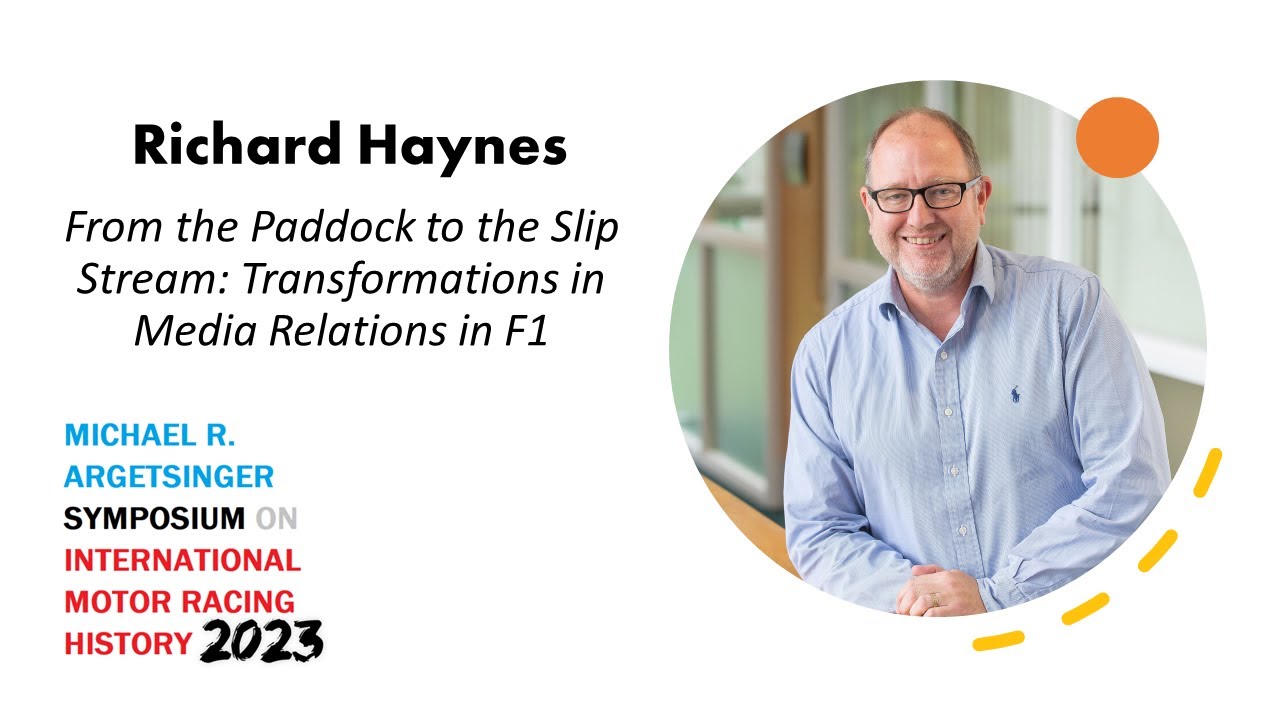
Based on archival and biographical research and interviews with British journalists, broadcasters and communications managers, this presentation provides an analysis of the transformations in media relations in Formula One from 1960s onward. The paper explores the professional careers of leading British journalists and broadcasters of F1 to explore how media relations have changed over time. We conclude with some thoughts on how F1 in the era of Liberty Media, is bringing new opportunities for F1 across different platforms, transforming again the media relations of the sport.
The International Motor Racing Research Center (IMRRC), partnering with the Society of Automotive Historians (SAH), presents the Seventh Annual Michael R. Argetsinger Symposium on International Motor Racing History. The Symposium established itself as a unique and respected scholarly forum and has gained a growing audience of students and enthusiasts. It provides an opportunity for scholars, researchers and writers to present their work related to the history of automotive competition and the cultural impact of motor racing. Papers are presented by faculty members, graduate students and independent researchers.
The history of international automotive competition falls within several realms, all of which are welcomed as topics for presentations, including, but not limited to: sports history, cultural studies, public history, political history, the history of technology, sports geography and gender studies, as well as archival studies.Show More
Dyson began racing professionally in IMSA GTO and the SCCA Trans-Am Series in 1982. The following year, to support his professional racing efforts, Dyson founded the Dyson Racing Team, which over the next few years grew to be one of America’s premier sports car racing teams. From it base in Poughkeepsie, over the course of nearly four decades the team won 19 championships, 72 race victories, started 72 times from the pole and achieved 224 podium finishes. Among the team’s notable accomplishments is a pair of overall victories in America’s premier endurance race, the Rolex 24, at Daytona International Speedway.
The team fielded cars during the heyday of the IMSA Camel GT, winning its first time out with a Porsche 962 at Lime Rock Park. Under Dyson’s leadership the team went on to successfully field entries in Indy car, the World Sports Car Championship, the United States Road Racing Championship, the American Le Mans Series (where the team scored two championships), the Rolex Sports Car Series, and the Pirelli World Challenge, where the team scored Bentley’s first-ever North American race victory.
During his 21 seasons as a professional racing driver Dyson drove in 92 races, scoring four overall race wins (including the 1997 Rolex 24 at Daytona) and a total of 18 podium finishes. Dyson continued to compete episodically in professional racing through 2007 and today remains active driving his collection of vintage Indy cars in a variety of demonstration events. Dyson’s personal historic Indy car collection ranges from a 1913 Isotta Fraschini tipo IM to Johnny Rutherford’s 1978 Budweiser McLaren M24B, and includes the 1961 Kimberly Cooper Climax, the first successful rear-engine car to compete in the 500.
Named chairman of the board of directors of the Indianapolis Motor Speedway Museum in 2021 following a decade as a member of the board, Dyson is guiding the institution through its $89 million transformational renovation as it charts its future path as the repository of the history and related artifacts of America’s oldest active and most storied racing facility.
In 2011 Dyson donated to the IMRRC the historic archives of National Speed Sport News, America’s premier motorsports news publication since the late 1930s.
Dyson is the chairman and chief executive officer of Dyson-Kissner-Moran Corporation, a privately-owned international holding company.
The International Motor Racing Research Center (IMRRC), partnering with the Society of Automotive Historians (SAH), presents the Seventh Annual Michael R. Argetsinger Symposium on International Motor Racing History. The Symposium established itself as a unique and respected scholarly forum and has gained a growing audience of students and enthusiasts. It provides an opportunity for scholars, researchers and writers to present their work related to the history of automotive competition and the cultural impact of motor racing. Papers are presented by faculty members, graduate students and independent researchers.
The history of international automotive competition falls within several realms, all of which are welcomed as topics for presentations, including, but not limited to: sports history, cultural studies, public history, political history, the history of technology, sports geography and gender studies, as well as archival studies.Show More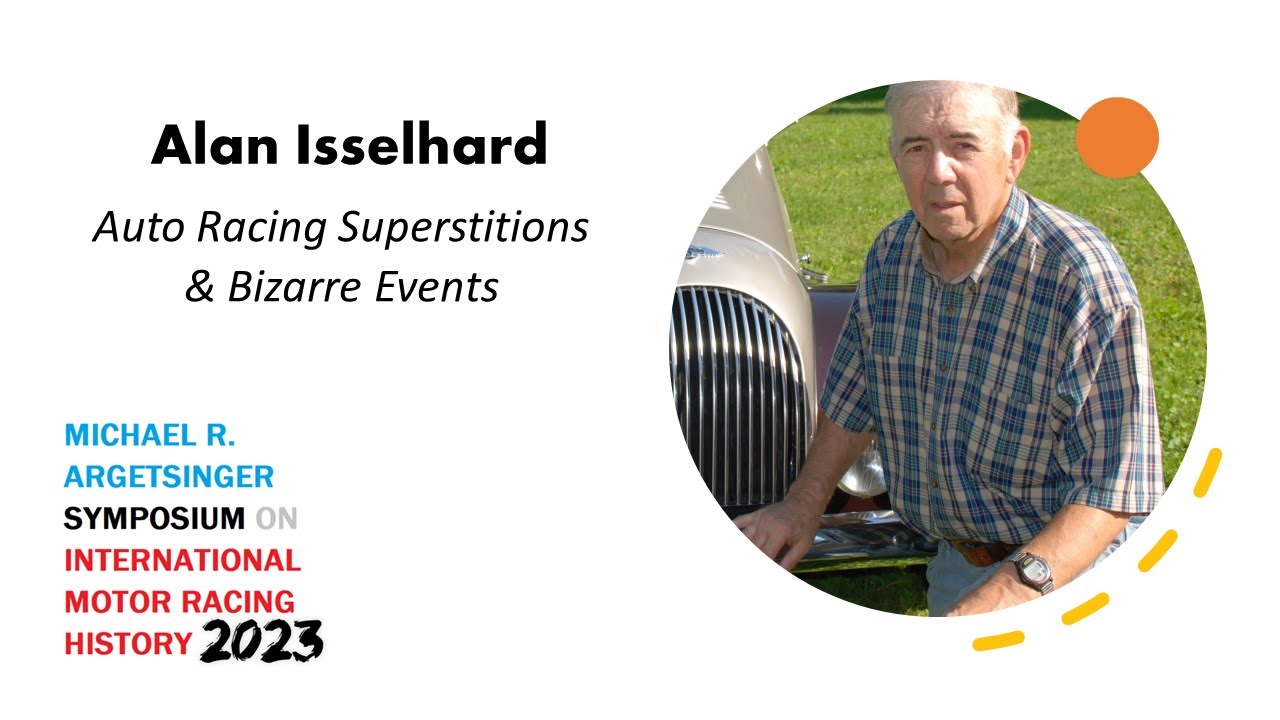
Superstitions, both good and evil, common and rare, affect all classes of people and their place in life and have been passed along generation after generation. Auto racing, from its very beginning, is not immune from superstitions - many of which can be described as bizarre and are present in today’s auto racing world.
The International Motor Racing Research Center (IMRRC), partnering with the Society of Automotive Historians (SAH), presents the Seventh Annual Michael R. Argetsinger Symposium on International Motor Racing History. The Symposium established itself as a unique and respected scholarly forum and has gained a growing audience of students and enthusiasts. It provides an opportunity for scholars, researchers and writers to present their work related to the history of automotive competition and the cultural impact of motor racing. Papers are presented by faculty members, graduate students and independent researchers.
The history of international automotive competition falls within several realms, all of which are welcomed as topics for presentations, including, but not limited to: sports history, cultural studies, public history, political history, the history of technology, sports geography and gender studies, as well as archival studies.Show More
McKim’s Legends of Racing Radio Show is a hugely popular forum for enthusiasts of the sport. Buz McKim was our Keynote Speaker for two prior Argetsinger symposia.
Mr. McKim’s presentation explores the racing career of NASCAR’s iconic founder William “Bill” France and the origins of NASCAR in the late 1940s and early 1950s. Big Bill’s exploits are legendary and his captivating and sometimes overwhelming style belie his extraordinary contribution to the evolution of professional motor racing in America. McKim’s presentation is a deeply informed and sympathetic portrayal of the man and his accomplishments.
The International Motor Racing Research Center (IMRRC), partnering with the Society of Automotive Historians (SAH), presents the Seventh Annual Michael R. Argetsinger Symposium on International Motor Racing History. The Symposium established itself as a unique and respected scholarly forum and has gained a growing audience of students and enthusiasts. It provides an opportunity for scholars, researchers and writers to present their work related to the history of automotive competition and the cultural impact of motor racing. Papers are presented by faculty members, graduate students and independent researchers.
The history of international automotive competition falls within several realms, all of which are welcomed as topics for presentations, including, but not limited to: sports history, cultural studies, public history, political history, the history of technology, sports geography and gender studies, as well as archival studies.Show More
Office for Simulation Training and Instrumentation.
Don is currently engaged in research surrounding the sport and contests sanctioned by the AAA from its beginning, including the American national auto racing championships, until the Contest Board ceased operations at the end of the 1955 season.
The International Motor Racing Research Center (IMRRC), partnering with the Society of Automotive Historians (SAH), presents the Seventh Annual Michael R. Argetsinger Symposium on International Motor Racing History. The Symposium established itself as a unique and respected scholarly forum and has gained a growing audience of students and enthusiasts. It provides an opportunity for scholars, researchers and writers to present their work related to the history of automotive competition and the cultural impact of motor racing. Papers are presented by faculty members, graduate students and independent researchers.
The history of international automotive competition falls within several realms, all of which are welcomed as topics for presentations, including, but not limited to: sports history, cultural studies, public history, political history, the history of technology, sports geography and gender studies, as well as archival studies.Show More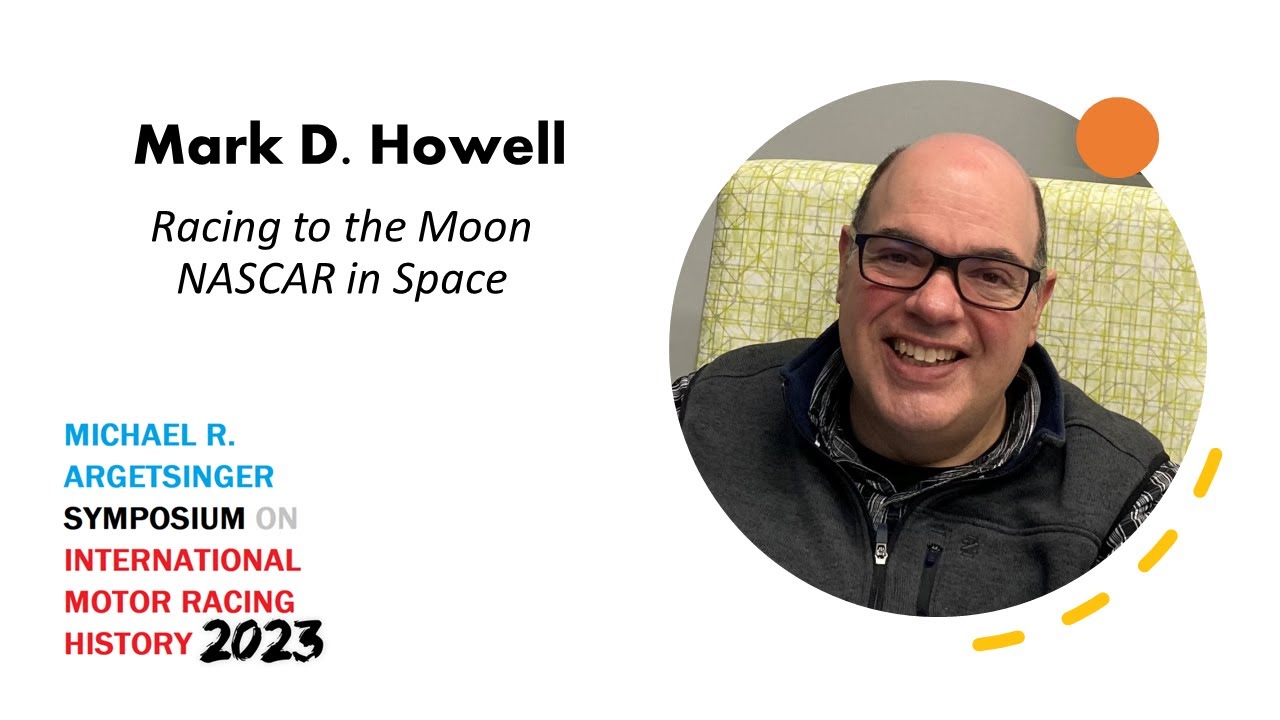
Howell is professor of communications at Northwestern Michigan College in Traverse City. He lives with his wife and son (and two dogs) in the village of Suttons Bay on Lake Michigan.
This presentation examines the 2023 alliance between Leidos, the international high-tech engineering firm, and NASCAR to build a “Next Gen” Lunar Roving Vehicle (LRV). The paper looks at the adaptation of motorsports culture by the aerospace industry as space exploration grows more privatized and commercialized. Additionally, the presentation looks at the history of NASA’s LRV program and how astronauts saw their rovers through the context of automobile racing. Both Leidos Dynetics and NASCAR are relying on particular language, imagery, and historic legacies to justify their partnership while trying to earn NASA’s new LRV contract by the end of November 2023.
The International Motor Racing Research Center (IMRRC), partnering with the Society of Automotive Historians (SAH), presents the Seventh Annual Michael R. Argetsinger Symposium on International Motor Racing History. The Symposium established itself as a unique and respected scholarly forum and has gained a growing audience of students and enthusiasts. It provides an opportunity for scholars, researchers and writers to present their work related to the history of automotive competition and the cultural impact of motor racing. Papers are presented by faculty members, graduate students and independent researchers.
The history of international automotive competition falls within several realms, all of which are welcomed as topics for presentations, including, but not limited to: sports history, cultural studies, public history, political history, the history of technology, sports geography and gender studies, as well as archival studies.Show More
Lerner’s presentation covers the early – and often controversial – efforts of TV to bring automobile racing into American living rooms. In 1961, a segment from the Indianapolis 500 time trials was broadcast as part of ABC’s new Wide World of Sports program. During the next few years, racing coverage was expanded to include Formula 1, Le Mans, NASCAR and even USAC dirt-track races. Television dramatically expanded the reach of the sport, which, in turn, attracted major commercial sponsors. By the 1970s, racing had been transformed into the global commercial engine we know today. Yet from the beginning, enthusiasts had a love-hate relationship with ABC. On one hand, TV coverage confirmed that racing was a legitimate sport rather than a tawdry carnival sideshow. On the other, serious fans found the broadcasts puerile and sensationalistic. The camerawork was shaky, the commentary insipid and the focus on accidents infamously morbid. Coverage of the fatal wrecks of Lorenzo Bandini and Roger Williamson inspired widespread disgust that led to improvements in safety. This was an unintended consequence, but it was a product largely of television’s unblinking eye.
The International Motor Racing Research Center (IMRRC), partnering with the Society of Automotive Historians (SAH), presents the Seventh Annual Michael R. Argetsinger Symposium on International Motor Racing History. The Symposium established itself as a unique and respected scholarly forum and has gained a growing audience of students and enthusiasts. It provides an opportunity for scholars, researchers and writers to present their work related to the history of automotive competition and the cultural impact of motor racing. Papers are presented by faculty members, graduate students and independent researchers.
The history of international automotive competition falls within several realms, all of which are welcomed as topics for presentations, including, but not limited to: sports history, cultural studies, public history, political history, the history of technology, sports geography and gender studies, as well as archival studies.Show More 6th Annual - 2022 Presentations
6th Annual - 2022 Presentations
IMRRC Symposium 2022 - Trevor Lister - Truth is the Daughter of Time
Upon completion of that work, he returned to his foundation automotive design skills and his motorsports hobby. At which point he became an inspector and certifier on other peoples' projects, as well as designing, building and racing his own cars. In semi-retirement, he took up teaching and tutoring pre-apprenticeship students in Mathematics, Science and Automotive Engineering.
In full retirement, he assumed the role of editor of the newsletter of The Classic Motor Racing Club of New Zealand. That is when, searching for newsletter stories, he came across the work of Donald Capps, and their common interest in old Maseratis. The upshot of working together on the histories of these cars became the main point in the presentation to this symposium.
It appears that Maserati in the 1950s identified their competition cars by their engine numbers, not their chassis numbers, and that this process allowed for the individual cars to have carried more than one identity. This has implications for the provenance of these cars.
This episode is sponsored in part by: The International Motor Racing Research Center (IMRRC), The Society of Automotive Historians (SAH), The Watkins Glen Area Chamber of Commerce, and the Argetsinger Family - and was recorded in front of a live studio audience.Show More
Upon completion of that work, he returned to his foundation automotive design skills and his motorsports hobby. At which point he became an inspector and certifier on other peoples' projects, as well as designing, building and racing his own cars. In semi-retirement, he took up teaching and tutoring pre-apprenticeship students in Mathematics, Science and Automotive Engineering.
In full retirement, he assumed the role of editor of the newsletter of The Classic Motor Racing Club of New Zealand. That is when, searching for newsletter stories, he came across the work of Donald Capps, and their common interest in old Maseratis. The upshot of working together on the histories of these cars became the main point in the presentation to this symposium.
It appears that Maserati in the 1950s identified their competition cars by their engine numbers, not their chassis numbers, and that this process allowed for the individual cars to have carried more than one identity. This has implications for the provenance of these cars.
This episode is sponsored in part by: The International Motor Racing Research Center (IMRRC), The Society of Automotive Historians (SAH), The Watkins Glen Area Chamber of Commerce, and the Argetsinger Family - and was recorded in front of a live studio audience.Show More
Mike Stocz is a senior lecturer of Sport Management & Leadership at the University of New Hampshire. He is one of the founding members and editor-in-chief of the Journal of Motorsport Culture & History. Mike's previous works have included a bottom up framing analysis of the Tony Stewart-Kevin Ward Jr. incident on Facebook, as well as explorations of legal issues in K-12 sport administration, an economic funding model for college athletics, and a textual analysis of the American Outlaws fan group in the digital space.
Kate Sullivan is an assistant professor in Strategy & Enterprise in Scotland's Heriot-Watt University, where she teaches a range of entrepreneurship and management courses as well as conducts research as a well-being and performance psychologist. She has also worked in the classic car industry for more than a decade. Ms. Sullivan personally holds several regional land-speed records.
In the roundtable, she explores the forgotten history of alternative power vehicles in motorsport, demonstrating that the current concerns over the environmental impacts of auto racing - and the attendant hand-wringing over its future - are far from new. Showing how alternative power vehicles have been part of society's need for speed from the beginning, she will suggest how to harness this worry to instead create new buzz for racing.
This episode is sponsored in part by: The International Motor Racing Research Center (IMRRC), The Society of Automotive Historians (SAH), The Watkins Glen Area Chamber of Commerce, and the Argetsinger Family - and was recorded in front of a live studio audience.Show More
Dr. Trey Cunningham is associate professor and chair of the Department of Sport and Motorsport Management at Belmont Abbey College. The college offers a four-year undergraduate academic program designed to prepare aspiring professionals and leaders for a career in the motorsport industry. The presentation will discuss Belmont Abbey College's pedagogical approach to introducing and reinforcing the history of motorsports throughout the entire curriculum. Moreover, Dr. Cunningham's presentation will discuss the many perceived lessons learned and ever-evolving adjustments made along the way in the Department's efforts to successfully prepare students to become lifelong learners of the history of Motorsports.
This episode is sponsored in part by: The International Motor Racing Research Center (IMRRC), The Society of Automotive Historians (SAH), The Watkins Glen Area Chamber of Commerce, and the Argetsinger Family - and was recorded in front of a live studio audience.Show More
This episode is sponsored in part by: The International Motor Racing Research Center (IMRRC), The Society of Automotive Historians (SAH), The Watkins Glen Area Chamber of Commerce, and the Argetsinger Family - and was recorded in front of a live studio audience.Show More
As a Motorsports historian, Dr. Howell has published numerous articles and two books: From Moonshine to Madison Avenue: A Cultural History of the NASCAR Winston Cup Series (1997) and Motorsports and American Culture: From Demolition Derbies to NASCAR (2014).
Since 2011, he has been a Senior Writer for frontstretch.com, where his essays appear every Wednesday during the racing season. Dr. Howell also spent three years (2001-2003) as a part-time crew member with Brett Bodine Racing in the Monster Energy NASCAR Cup Series, and has worked closely with drivers Hut Stricklin, Kenny Wallace, and Todd Bodine.
This episode is sponsored in part by: The International Motor Racing Research Center (IMRRC), The Society of Automotive Historians (SAH), The Watkins Glen Area Chamber of Commerce, and the Argetsinger Family - and was recorded in front of a live studio audience.
The history of international automotive competition falls within several realms, all of which are welcomed as topics for presentations, including, but not limited to: sports history, cultural studies, public history, political history, the history of technology, sports geography and gender studies, as well as archival studies.
The symposium is named in honor of Michael R. Argetsinger (1944-2015), an award-winning motorsports author and longtime member of the Center's Governing Council.Show More
The history of international automotive competition falls within several realms, all of which are welcomed as topics for presentations, including, but not limited to: sports history, cultural studies, public history, political history, the history of technology, sports geography and gender studies, as well as archival studies.
The symposium is named in honor of Michael R. Argetsinger (1944-2015), an award-winning motorsports author and longtime member of the Center's Governing Council.Show More
This episode is sponsored in part by: The International Motor Racing Research Center (IMRRC), The Society of Automotive Historians (SAH), The Watkins Glen Area Chamber of Commerce, and the Argetsinger Family - and was recorded in front of a live studio audience.Show More
Mr. McKim's presentation explores the origins of modified stock car racing in the illegal distribution of untaxed adult beverages, or "moonshine." He recounts the development of NASCAR in 1949 and its evolution in the 1950s from a truly "stock" competition to a manufacturer-supported testing ground for advances in the engineering and design of American automobiles. Mr. McKim's talk describes the irony of how the automotive engineering modifications inspired by "wild country boys" led to all-around improvements in automotive technology.
This episode is sponsored in part by: The International Motor Racing Research Center (IMRRC), The Society of Automotive Historians (SAH), The Watkins Glen Area Chamber of Commerce, and the Argetsinger Family - and was recorded in front of a live studio audience.Show More
This episode is sponsored in part by: The International Motor Racing Research Center (IMRRC), The Society of Automotive Historians (SAH), The Watkins Glen Area Chamber of Commerce, and the Argetsinger Family - and was recorded in front of a live studio audience.Show More
This episode is sponsored in part by: The International Motor Racing Research Center (IMRRC), The Society of Automotive Historians (SAH), The Watkins Glen Area Chamber of Commerce, and the Argetsinger Family - and was recorded in front of a live studio audience.Show More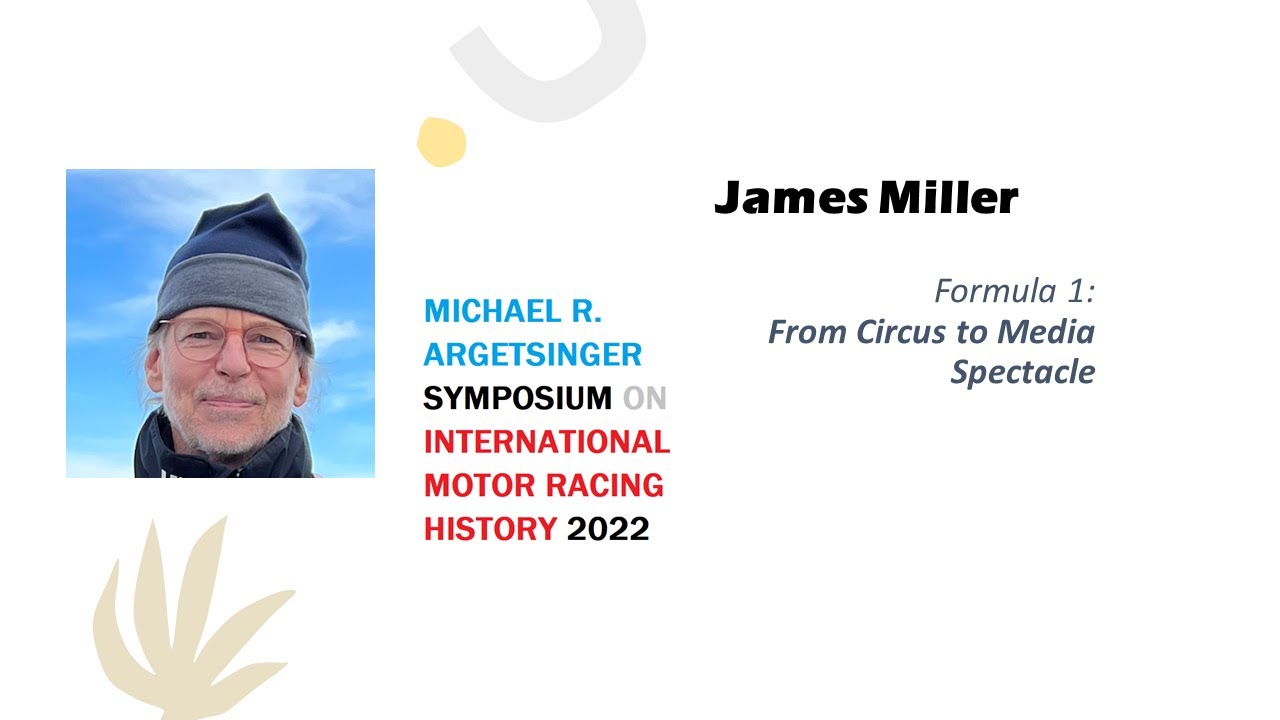
Dr. Miller is professor emeritus of communications at Hampshire College. He has studied new media as a Fulbright researcher in Paris and a visiting professor at MIT's Media Lab.
The history of international automotive competition falls within several realms, all of which are welcomed as topics for presentations, including, but not limited to: sports history, cultural studies, public history, political history, the history of technology, sports geography and gender studies, as well as archival studies.
The symposium is named in honor of Michael R. Argetsinger (1944-2015), an award-winning motorsports author and longtime member of the Center's Governing Council.Show More
► Check out our membership program ...and go VIP at: https://www.patreon.com/join/gtmotorsports
►► Other cool stuff: https://www.gtmotorsports.org/linksShow More
Thank you for your support!
We would like to thank our sponsors and volunteers for the continued support of the Annual Argetsinger Symposium. If you’d like to contribute to the success of this event, please don’t hesitate to reach out to research@racingarchives.org for more information.